
We study the energy spectra obtained within tight-binding model for hexagonally-shaped graphene quantum dots (GQDs) subjected to external magnetic field. Energy spectra of periodic structures in the presence of magnetic field show recursive nature, if plotted as a function of magnetic flux and they are known as Hofstadter's butterflies [1].
We identify the self-similar gaps in subbands of the spectra and label them by two integers (t,s) satisfying the Diophantine equation. Therefore, we construct their linear trajectories in the form of the density-field diagram (Wannier diagram) [4]. In the spectra for relativistic carriers in graphene a special sequence of Landau levels can be identified. It is shown that their square root dependence on magnetic field is true for the nanostructures studied. Moreover, size effects and edge type influence on the Hofstadter spectra and electronic density are investigated.
Recently, in attempt to observe such fractal dependencies in experiment (with low magnetic fields), heterostructures of graphene coupled to hexagonal boron nitride and their spectra have been studied [2]. Superlattices arising in such structures have been predicted to break the A-B sublattice symmetry and, as a consequence, to open a band gap at the charge neutrality points [3].
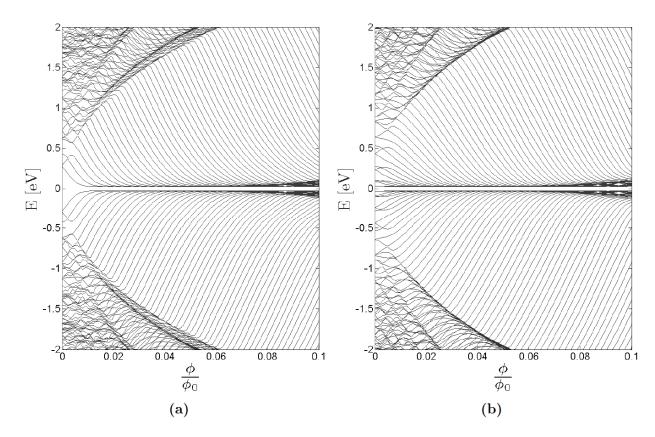
The substrate effects for GQDs studied here are modelled with 'staggered' potential component of the Hamiltonian [5], which breaks the sublattice symmetry. This produces an energy gap in the zeroth Landau level persisting uninterrupted for the whole range of magnetic flux studied (fig. 1.)