
Over 70% of all nuclei in the Periodic Table have a spin quantum number greater than one half ($I \ge 1$). Therefore their quadrupolar moment interacts with electric field gradient. And unlike in liquid-state, in solid-state NMR spectroscopy chemical shift anisotropy, dipole-dipole coupling and quadrupolar interactions are not averaged my rapid molecular tumbling. The last mentioned interaction is denoted by the spin Hamiltonian for the full electric quadrupolar interaction of the spin I:
$$ \widehat{H}_{Q}^{full} = \frac{eQ}{2I(2I-1)\hbar} \widehat{I}\widehat{V}\widehat{I}; \tag{1} $$where tensor V is electric field gradient and Q is quadrupolar moment [1]. If quadrupolar interaction is considerable compared to Zeeman effect, standard perturbation theory is used. Depending on interaction strength first-order ($H_Q^{(1)}$) and if needed second-order ($H_Q^{(2)}$) expansion terms are considered.
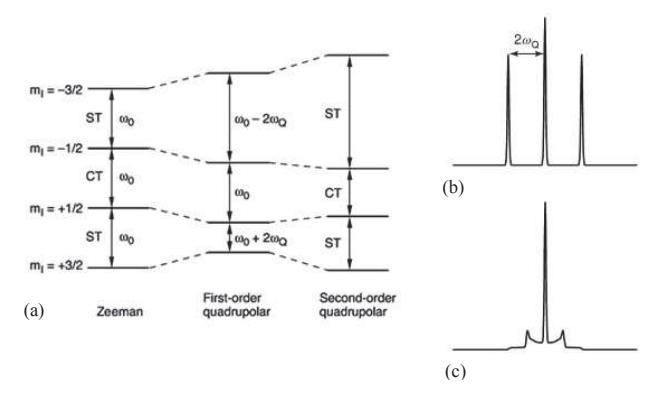
$H_Q^{(1)}$ term splits the central line into 2I-1 satellite lines but the central line remains at Larmor frequency $w_0$ [2]. Second-order term shifts all of the lines, including the central line, but this effect is observed only with strong quadrupolar interactions [2]. These effects make the interpretation of spectra more difficult. First-order term is proportional to second-order Legrande polynomial which itself can be evaluated to zero by picking angle of 54.7°, where it is angle with polarizing field $B_0$ allowing to average $H_Q^{(1)}$ term to zero. This method is called Magic Angle Spinning and is commonly used in solid-state NMR spectroscopy, however it does not eliminate second- order $H_Q^{(2)}$ expansion term, because it is equivalent to fourth-order Legrande polynomial. Although there are methods to average this term such as Double Rotation (DOR), it is uncommon since second-order perturbation usually has insignificant effect in NMR spectra.