
2-naphthol forms as a secondary product of many industrial activities, such chemical, paper and paint, pesticide industries, and is known as a hazardous substance for human beings and the environment. DBD methods are advantageous over advanced oxidation procedures (AOP) when reactive oxidative species generation is considered.
The degradation of 2-naphthol was examined in a pilot dielectric barrier discharge (DBD) pilot setup. Plasma was generated in a quartz tube with ambient air used as a feed gas for the reactor. The performance of the reactor was evaluated according to the ozone amount produced, both in gas and liquid phase, as well as the overall decomposition efficiency of 2-naphthol.
A screening experiment was performed to find the most important process parameters, followed by the 2-naphthol decomposition kinetics experiment. The largest negative response was obtained for the initial concentration of 2-naphthol with the decomposition efficiency decreasing when increasing 2-naphthol concentration. The increasing power and higher aeration intensity resulted in a positive significance towards 2-naphthol decomposition efficiency.
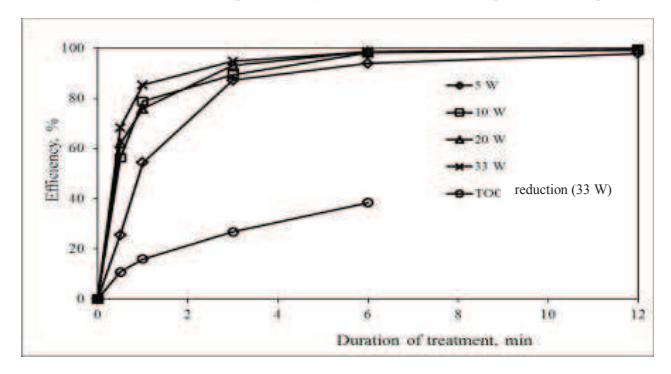
The greatest decomposition efficiency was achieved when using 20W and 33W of power (Fig. 1). The major amount of 2-naphthol (about 90%) was decomposed after the first 2 minutes (2.6 and 1.95 min, respectively). These data are in a good agreement with the measured TOC values, where after 6 min at 33 W DBD power 38.4 % mineralization degree was achieved.
The intermediary reactive products of 2-naphthol decomposition were determined using a combination of FTIR and GC/MS analyses. The degradation intermediates consisted mostly of oxygen containing functional groups: carboxylic acids, as well as amides and amines.
DBD plasma can be successfully applied for decomposition of 2-naphthol in water. This technology is quite universal, efficient and suitable for decomposition of most chemical compounds, including most stable chemicals. Also DBD can be used in combination with a secondary method, capable to decontaminate low resulting concentration products.