
It is often thought that endogenous interactions are behind many big spontaneous events observed in the complex socio-economic systems. Social cooperation, spontaneous emergence, formation of financial bubbles, financial flash-crashes and even mass panic may be caused by the endogenous dynamics and certain general similarities of human psychology [1, 2]. The tendency to rely on others, importance of social interactions, tight coupling suggests that it might be possible to influence the collective behavior of the complex socio-economic systems.
One of the suitable frameworks to test this idea is known as agent-based modeling [3, 4]. In this framework a generalized entity, known as agent, is used in place of real-life interacting parts of the modeled system. While the real-life interactions might be very complex, agents are frequently assumed to interact by following very simple rules. Despite the underlying simplification the complex collective behavior emerges as a result of the interactions between these agents.
In this contribution we consider agent-based herding model proposed by Alan Kirman [5], which explains herding behavior in ant colonies and is also successfully applied to other socio-economic scenarios [6]. Leadership can be introduced into this model rather simply by assuming that some of the agents occupy fixed states and may interact with every other agent in the system. In this case one agent transition probability (from state i to state j) takes the following form:
$$\mu(i \to j) = \left[\sigma_j + \frac{h}{N}X_j + hM_j\right] \Delta t,$$here $\sigma_j$ is the individual transition rate to state j, h is responsible for herding behavior transitions, $M_j$ is a number of leaders in the j state. Note that $\Delta t$ in the above should be small enough for only one transition to be probable.
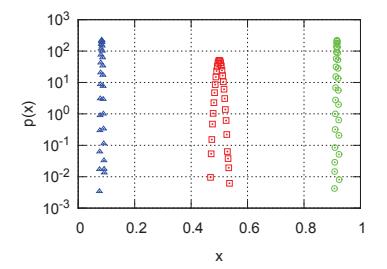
As you can see in the figure above the leaders, despite being only in a small number, are able to significantly impact the output of a large system. This result suggests some of the possible applications - one may facilitate spread of a new technology or product by donating it to influential individuals (e.g., government, journalists), central banks and market regulators could stop financial bubbles and crashes by initiating trades based on the economic fundamentals rather than plain speculation.