In recent years, optical parametric chirped-pulse amplification (OPCPA) has emerged as a powerful tool for the generation of ultrashort pulses with extreme peak intensity, which are used in different domain of physics, such as nonlinear relativistic optics, heavy particle acceleration and many more [1]. The basic idea beyond this sophisticated method is to amplify and compress an ultrashort laser pulse without the onset of accumulating self-action effects (self-focusing, self-phase modulation, and eventually optical damage) imposed by optical nonlinearities in the amplifier. This is done by stretching the pulse in time by a dispersive element and thereby decreasing its peak power, then amplifying its energy and finally recompressing pulse to its original duration.
In this work we analise different compressors made from combinations of bulk materials by modeling temporal behaviour of the pulse and possible nonlinear effects during the compression. For the evaluation of the nonlinear phase shift and the effects of self-phase modulation so called B-integral is calculated:
$$B = \frac{2\pi}{\lambda} \int n_2 |E(\mathbf{r}, t)|^2 dz, \tag{1}$$where $n_2$ is the nonlinear component of the refractive index. If $B \le 1$, the effects are said to be negligible [2]. Propogation of pulse in the material is described by generalized nonlinear Schrödinger equation (2):
$$i\frac{\partial A}{\partial x} = i\frac{\alpha}{2}A(z,t) + \frac{1}{2}\beta_2\frac{\partial^2 A}{\partial \tau^2} - \frac{1}{6}\beta_3\frac{\partial^3 A}{\partial \tau^3} - \gamma|A|^2A(z,t), \tag{2}$$where $\beta_2 = (\partial^2 k/\partial \omega^2)$ represents dispersion of the group velocity, $\beta_3 = (\partial^3 k/\partial \omega^3)$ represents group delay dispersion, $\gamma$ is related to the nonlinear refractive index $n_2$ by the relation $\gamma = n_2\omega_o/c$, and $\tau = t - z/v_g$.
Split step Fourier method is used to numerically evaluate (2). The length of material is divided into large number of segments and the propagation of the optical pulse within each segment is calculated in two steps. During the first step only operator which takes into account dispersion is acted on the Fourier transform of the pulse while in the second step only operator describing nonlinear effects is acted on the output pulse. By this procedure, the pulse is propagated from segment to segment, and the degradation effects on the pulse can be studied at the output end of the material.
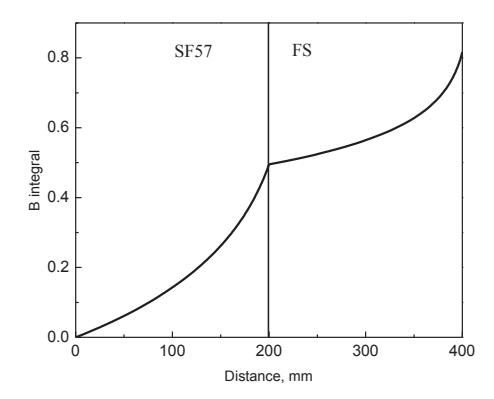
In this graph we present B-integral accumulation in the compressor consisting of 200 mm SF57 optical glass and 200 mm Fused Silica glass, for 10 mJ pulses and 5 cm beam diameter. Initial pulse of 40 ps was compressed to 200 fs and the B-integral value is estimated to be below 0.82. Various configurations of compressors with the evaluations of B-integrals will be presented in the poster presentation.