
Thin film metal oxide sensors are frequently used for gas detection but the success of practical applications is typically limited by comparatively high operating temperatures. It seems reasonable to expect that this problem can be solved by creating a new type of sensors. It was demonstrated by our experiments that very thin multi-layered metal oxide structures convert surface chemical interaction into a detectable electrical signal. However detailed studies are required for better understanding of the charge carrier transfer mechanism.
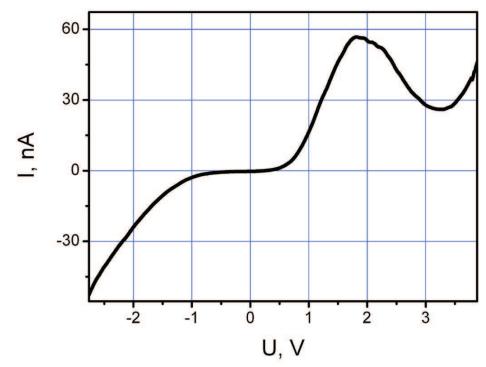
In the ultra-thin layers (~10nm) based on non-stoichiometric metal oxides In2-xO3-y and TiO2-x a negative differential resistance (NDR) is typically detected as it can be seen in the I-V dependence in figure 1. Our experiments proved that the NDR is detected if a negative potential is applied to the substrate for at least a few seconds. The external voltage must be not less than several volts, e.g. 4.5 V. If a polarity of the probing voltage is opposite to the activating one the NDR is typically detected in the I-V curve. Considering the results of our studies in [1], we think that the NDR can be explained by redistribution of the oxygen vacancies in the TiO2 lattice similar to that proposed in [2]. It must be noted here, that the redistribution does not produce noticeable changes in the topography of the studied structures as it was reported in our previous work [1]. The NDR monotonically decreases and disappears finally as the system returns to the initial state. Spontaneous drift produced by the voltage is obtained in the tested structures.
We can conclude that in spite of general understanding of the NDR in local I-V in the multilayered ultra-thin metal oxide structures there are still essential uncertainties about the mechanism of the electrical charge transfer across the structure. Thorough investigations are being done to explain transport mechanism in detail.