Co-W is nominated as a promising environmental friendly alloy to replace hard chromium due to the satisfactory appearance of the coating, and their mechanical and anti-corrosion properties. In this work Co-W alloy coatings were deposited by DC at 60 °C onto stainless steel substrates from citrate electrolytes with different pH (5 ÷ 8). The corrosion resistance of prepared Co-W coatings was studied in 0,01 M H2SO4 solution open to air and at 24±1 °C. The corrosion test consisted of electrochemical impedance spectroscopy (EIS) at open circuit potential (OCP). The amplitude of the modulation potential for the EIS measurements was 5 mV, and the frequency range was 10 kHz-0,01 Hz. The structure, morphology and composition of deposited alloy coatings were determined by X-ray diffraction, scanning electron microscopy (SEM), and energy dispersive X-ray spectrometer (EDS) respectively.
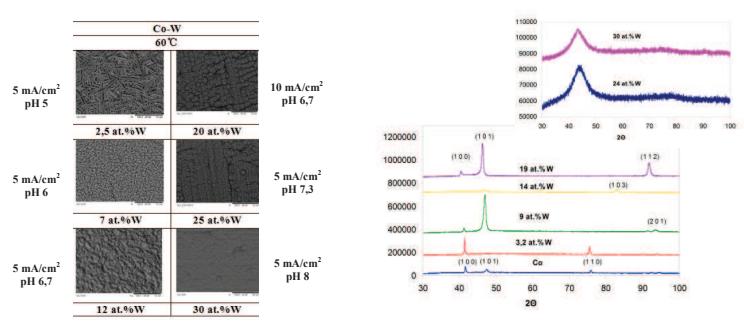
The influence of the pH and current density on Co-W deposits is shown in Fig. 1. It is seen that the morphology evolves from coarse-grained lenticular growth to nodular growth. Typical changes in the diffraction patterns of Co-W coatings with different W content is shown in Fig. 2. Increasing W content in the studied alloys results in a broadening of the diffraction peaks, indicating that the crystallographic texture changes to “amorphous-like”.
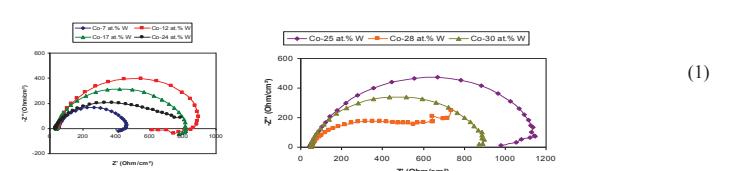
The Nyquist plots for various alloys are presented in Fig. 3. Generally, the corrosion resistance of Co-W alloys increased with W content up to 25 at.% and then decreased.