
Current breakthrough in nanotechnology is particularly important for biomedicine, where nanoparticle-based assays have shown a great promise in battle against the most common diseases. During the last few years gold nanoparticles have had an important role in cancer diagnostics and treatment because of their extensive scale of sizes, easy surface functionalization and advantageous properties such as localized surface plasmon resonance and fluorescence.
Extra small fluorescent gold nanoparticles - gold nanoclusters (AuNCs), composed of several gold atoms, demonstrate great potential for in vivo tumor imaging and are considered as novel, effective contrast agents because of their biocompatibility and easy modification process for a specific application or selective uptake [1]. Although future perspectives are promising, there are still some obstacles to overcome. Overlapping AuNCs and tissue fluorescence bands as well as insufficient fluorescence intensity are the main problems that prevent further experiments.
This research demonstrates that fluorescence intensity of MES (2-(N-morpholino)ethanesulfonic acid) capped AuNCs could be increased a few times depending on synthesis temperature [2]. During this experiment fluorescent gold nanoparticles were synthesized using Bao et al. [3] suggested method in the temperature range from 37°C to 85°C. As it is shown in Fig. 1 room-temperature Au NCs have a fluorescence peak at 480 nm (excitation peak is at 420nm). Synthesis at different temperatures have not shown any effect on these parameters although fluorescence intensity has grown more than five times with increasing synthesis temperature from 37°C to 70°C. However, higher temperatures lead to decrease of fluorescence intensity and formation of more precipitates instead.
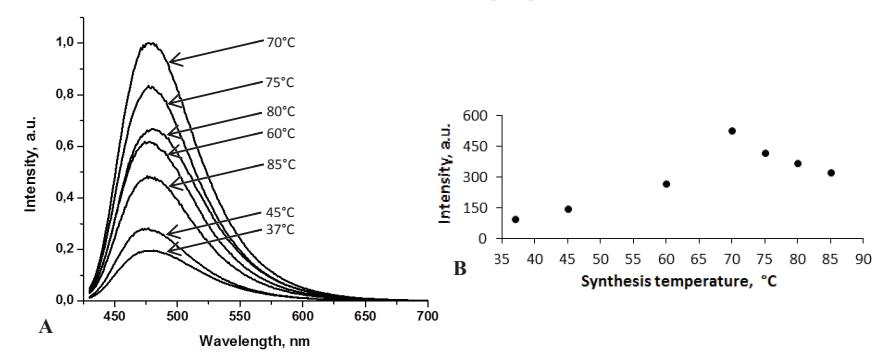
The growth of fluorescence intensity with higher temperatures can be result of increased oxidation potential of MES and related kinetics. Higher temperatures influence the efficiency of entire synthesis reaction products including non-fluorescent gold particles present in the colloid. After a temperature reaches a certain critical point, more large non-fluorescent particles are formed in the expense of small fluorescent AuNCs and therefore fluorescence intensity decreases.
In our observations all synthesized fluorescent AuNCs show great stability over time and can be concentrated up to ten times without any unfavourable changes.
Results obtained from this research show a method that allows to increase fluorescence intensity of MES capped AuNCs. In our knowledge this dependance on temperature in range from 60°C to 85°C is described for the first time and have never been published in any other references.