
There are numbers of various mixing formulae proposed for calculating the effective permittivity of a mixture [1]. For such analysis, the most suitable approach taken is the effective medium approximation (EMA). One of the main models, derived using differential analysis is Lichtenecker's mixing formulae [2]. The effective macroscopic response of the composite mixture is calculated according to its constituents.
Barium titanate and nickel-zinc ferrite composites, having chemical formula $xBaTiO_3 - (1-x)Ni_{0.5}Zn_{0.5}Fe_2O_4$ with the volume fractions x=0.466, 0.567 and 0.67, were investigated by the means of the broadband dielectric spectroscopy methods. The measured frequency and temperature ranges are 20 Hz to 50 GHz and 100 K to 500 K. Dielectric spectroscopy results indicate that the properties of pure barium titanate are preserved however, noticeable conductivity is induced due to the ferrite phase of the composite.
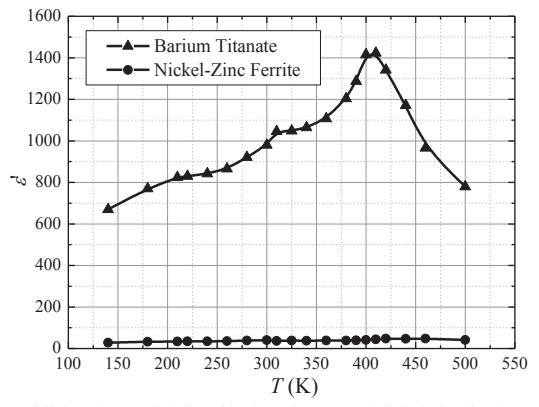
Lichtenecker's mixing formula was adapted in the approximation process of the experimental effective permittivity data of the composite ceramics. The results of the calculated dielectric response in composites, presented in Figure 1, manifest the presence of three peaks corresponding to phase transitions of pure barium titanate. The values are in a good agreement with the typical values which could be expected for barium titanate ceramic materials. On the other hand, nickel-zinc ferrite exhibits almost no dependency on the temperature, and the real part of permittivity is much smaller in comparison to the ferroelectric part.