
Cortisol is a steroid hormone, produced in human body by the zona fasciculata of the adrenal cortex. It's plays a major role in response to stress and a low level of blood glucocorticoids [1]. Cortisol level measurement is important for pituitary and adrenal cortex functions monitoring. The majority of such diagnostic systems for cortisol quantitative measurement utilize the principle of cortisol affinity recognition by antibodies (immunoglobulins) IgG isotype.
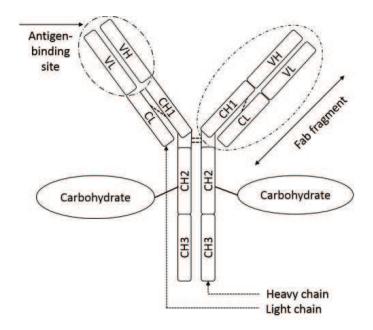
The IgG molecule consists of four polypeptide chains, two heavy chains of approximately 50 kDa, divided into four structural domains (VH, CH1, CH2, CH3); and two light chains of approximately 25 kDa, divided into two structural domains (VL and CL). The heavy and light chain variable domains (VH and VL) associate to form antigen-binding site, and the minimal stable unit, possessing the antigen binding activity, is Fab fragment (Figure 1).
Hybridomas 5G-H2 synthetizes antibodies, which tightly bind steroid hormone cortisol. However, the use of hybridoma lines producing monoclonal antibodies has a number of disadvantages; among the others include the instability of cell lines and the high cost of their cultivation. Furthermore, the expanded hybridoma lines can lose their ability to produce a specific monoclonal antibody after prolonged growth in culture. Thus, immortalization of valuable clones by cloning antibody genes into bacterial system and sequencing them should be carried out. Moreover, recombinant antibodies and their fragments, like a Fab fragment give a unique opportunity for antibodies functions and properties manipulations [2].
Using the hybridoma cell line 5G-H2, secreting monoclonal antibodies against steroid hormone cortisol as a source of mRNA and cDNA respectively, light and partially heavy chain gene fragments of Fab domain were amplified by the polymerase chain reaction (PCR). A set of degenerate oligonucleotide primers, covering all the family of mouse immunoglobulins IgG isotype was designed, according to the web-database IMGR.org alignment. Rare restriction sites were incorporated into VL and VH chains and used for cloning it into expression vector.
Expression of rFabs was carried out using bicistronic plasmid vector, which was constructed on the basis of pCWori-LIC plasmid and has two signal peptides pelB before N-terminal residues of VL and VH chains for protein transport into periplasmic space, and 6His amino acid tag fused to VH chain to facilitate rFab purification by IMAC [3]. Due to the appropriate redox potential in the bacteria periplasm recombinant protein folds correctly and could be isolated in soluble and active form. In order to express rFabs Escherichia coli BL21 expression strain was used.
Periplasmatic fraction was isolated by means of using cold osmotic shock. The protein of interest was isolated (and simultaneously purified) by metal affinity purification (IMAC) on Ni-IDA sepharose and then dialyzed.
Homogeneity of antibodies fragments was controlled by SDS-PAGE electrophoresis. The results indicates the presence of two amino acids chains with estimated molecular weight (25 kDa and 27 kDa for VL and VH chains respectively), confirming the effectiveness of the selected strategy and designed constructs. Binding activities of rFab and hybridoma secreted immunoglobulin were measured and no significant difference between them was revealed.