
The development of technology of stacking thin layers enabled production of quantum dots with desired parameters, such as size and composition. Additionally carrier confinement in three dimensions allows the emission of quantum dots to be highly tunable. We can create accurate lasers using quantum dots. One of the advantages is small spectral widening.
Lasers based on quantum dots have many virtues, but unfortunately also low efficiency. The reason is small volume of dots, which leads to low density of states and insufficient supply of carriers. One of proposed solutions is quantum well-quantum dot tunnel injection structure. It was shown experimentally, that quantum well, used as a reservoir with high density of states, located near a quantum dot increases efficiency of carriers injection due to phonon-assisted relaxation processes. We provide theoretical model and investigate the problem numerically. We study the dependence of the relaxation time on the system parameters.
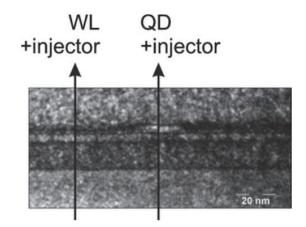
We have simplified numerical calculations using cylindrical symmetry of the system. Taking into account cylindrical coordinates we substitute Laplacian by its new form:
$$\nabla^2 = \frac{1}{r} \frac{\partial}{\partial r} r \frac{\partial}{\partial r} + \frac{1}{r^2} \frac{\partial^2}{\partial \theta^2} + \frac{\partial^2}{\partial z^2}, \tag{1}$$and the wave function
$$\Psi(r,\theta,z) = e^{iM\theta} \varphi(r,z),\tag{2}$$where M is angular momentum eigenvalue.
This allowed us to reduce problem from three to two dimensions and add third dimension dependence after all calculations.