
Diamond is one of the most promising wide-gap materials for applications in high power/high frequency sensors/transducers and radiation tolerant particle detectors [1]. However, the impact of the technological defects is clarified insufficiently, when the prevailing metal and nitrogen impurities are distributed non-homogeneously. The excess carrier lifetime is one of the most sensitive parameters to electrically active defects in material. Also, carrier lifetime is the main limiting factor for charge collection efficiency in diamond based sensors and detectors. Thereby, control of the recombination parameters enables ones to correlate the distribution of the technological impurities with the grown-in defects and to separate the prevailing channels of radiative and non-radiative recombination.
The wafer samples were sliced from the diamond single crystals (Fig. 1), synthesized by the high pressure (4.5-5.0 GPa) and high (1350-1450°C) temperature (HPHT) technology using the Ni-Fe liquid solvent/catalyst system.
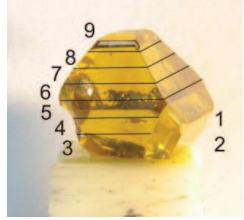
In this work, the profiling of the microwave probed photoconductivity transients and time resolved photoluminescence spectra have synchronously been performed on the synthetic diamond wafer samples in order to clarify correlation of the distribution of the grown-in defects and carrier radiative and non-radiative recombination channels. To estimate the microscopic characteristics of the grown-in defects, the microscopy imaging and the angular and temperature dependent EPR spectroscopy have been performed (Fig. 2a). FTIR spectrometry (Fig. 2b) has been performed on diamond samples in order to measure the variations of the grown-in impurity density by analyzing intensities of defect specific IR peaks [2].
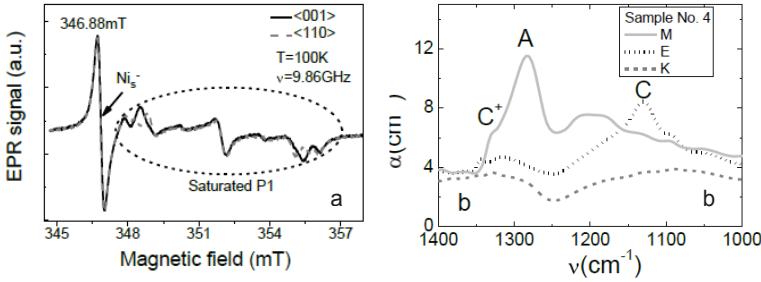
The correlation between the parameters extracted from the absorption spectra and recombination characteristics has also been obtained. The changes of carrier lifetime ascribed to the radiative and non-radiative recombination have been resolved. The prevailing grown-in point defects, associated with neutral and charged nitrogen impurity complexes as well as the pairs of nitrogen atoms on neighbouring sites, and the precipitates have been unveiled.