
The Jaynes-Cummings model [1] is known as a basic model of interaction of a simple two-level atom with a single mode of a quantum electromagnetic field in a cavity. The fluctuation of the number of photons in the mode of the electromagnetic field leads to collapses and revivals of quantum Rabi oscillations in the two-level system. The model has been widely used to describe interaction of quantum system including quantum dots [2] and graphene [3]. The classical simulation of the quantum Jaynes-Cummings model could be of interest due to the simplicity of experimental implementation and ability to observe different dynamic regimes of atom-light interaction.
We describe a semi-classical simulation of the Jaynes-Cummings model based on an interaction of mesoscopic atomic ensembles with a laser radiation, which is considered as a classical electromagnetic field. We show that the Jaynes-Cummings dynamics of Rabi oscillations could be observed in mesoscopic ensembles of Rydberg atoms in the regime of Rydberg blockade due to the $\sqrt{N}$ dependence of the frequency of the collective Rabi oscillations (Fig. 1) on the number N of interacting atoms [4] and random loading of atoms in the optical dipole traps [5]. The Jaynes-Cummings Hamiltonian is written as [1]
$$ \hat{H}_{\text{JC}} = \frac{1}{2}\hbar\omega_0\hat{\sigma}_z + \hbar\omega\hat{a}^{\dagger}\hat{a} + \hbar\gamma(\hat{\sigma}^{+}\hat{a} + \hat{\sigma}^{-}\hat{a}^{\dagger}) . \tag{1} $$Here $\omega_0$ is the transition frequency between atomic states, $\omega$ is the frequency of laser radiation, $\gamma$ is the coupling strength, $\hat{\sigma}^-$ and $\hat{\sigma}^+$ are the lowering and raising operators for the atomic levels, $\hat{a}$ and $\hat{a}^{\dagger}$ are lowering and raising operators for the quantum electromagnetic field. We show that the effective interaction between rydberg atoms in the mesoscopic ensemble is described by a Hamiltonian, that has the same form as the iteraction term in the Jaynes-Cummings Hamiltonian (1).
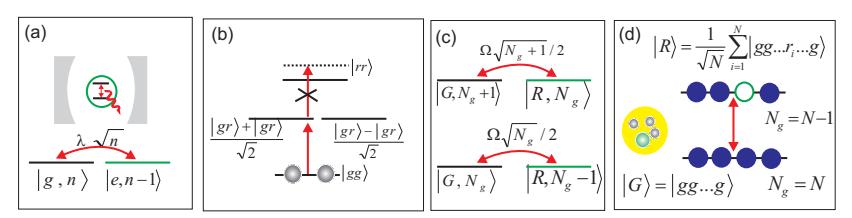
We also analyse the cases when the Rydberg blockade breaks down and it is possible to excite more than one atoms to the Rydberg state. Finally, we check whether the dynamics are affected by the spontaneous transition from the Rydberg state to the ground state. The atoms considered in the all the numerical calculations are Rb with 80S Rydberg state. Interaction between such atoms can be described by the Van der Waals potential.