
Recently we have formulated a simple Monte Carlo model [1] for the study of the photomechanical effect in polymeric fibers pumped with a linearly polarized laser beam. The model fiber is a host - guest system consisting of the polymeric matrix and azodye chromophores, which undergo multiple trans - cis - trans cycles when illuminated by linearly polarized light. Results that will be presented are focused on the topic closely related to the hypothetical cooperative mechanism of stress relaxation - on the characterization of local voids in computer-generated polymeric matrix (on discreet 3D lattice). We study void-size distributions and void-void correlation functions, all using bond-fluctuating model and Monte Carlo simulations.
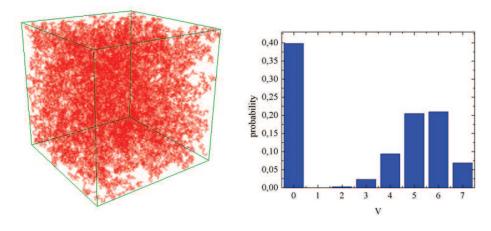
After a proper preparation of polymeric matrix (Fig. 1 - left), we introduce local void parameter. It divides cells in view of possibility of movement for foreign objects - so called steric restriction.
Character of local void parameter distribution (Fig. 1 - right) is highly polarized - two groups of strong (V = 0 – 4) and weak (V = 5 – 7) steric restriction are easily distinguishable. We may suppose that general behaviour and properties of the system will not change together with the change of local void definition.
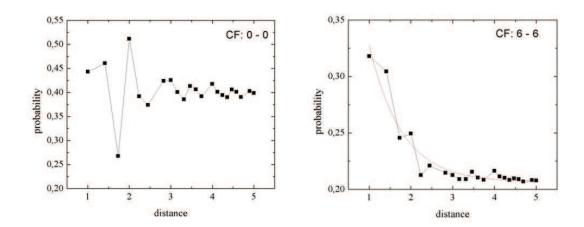
In Fig. 2 we show plots of correlations functions for cells representing strong (left part) and weak (right part) steric restriction. In the first case we observe typical for liquids oscillations. The second case is very different and displays a decay of correlations with superimposed oscillations which decay with distance. The decay can be fitted by an exponential function. This implies that there is a charatecirstic length d7 = 2.5-3 which characterizes the decay of 7-7 correlations. In other words, a cube with size 5 - 6 is a typical domain where steric interactions are weak.