
By combining multiple laser beams a standing wave pattern of laser intensities can be created, which, when filled with ultra-cold atoms acts as a periodic potential. This potential can be easily tuned by changing the corresponding intensities of laser beams. In this work we are studying Lieb and Kagome lattices.
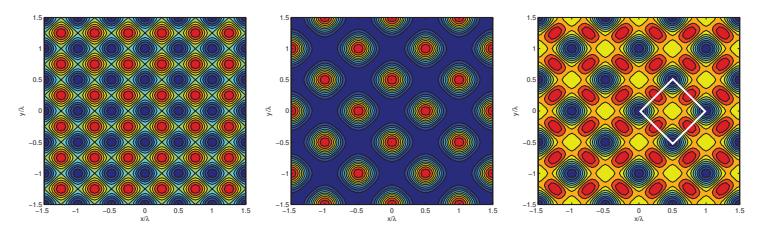
Formerly the Lieb lattice has been constructed by using laser beams with 12 different wave vectors [1] in our work a new way to create optical Lieb lattice was proposed by superimposing two square lattices(with in-plane and normal polarizations) with 4 wave vectors each, thus simplifying the experimental setup (Fig 1). The resulting potential consists of corner sites at minimum and line-center sites at maximum.
Ytterbium atoms feel different potential sign according to their internal state, thus an antimagic wavelength is chosen so that the atoms in ground and excited states would be trapped in line-center and corner sites of the primitive cell respectively.
In order to analyse these periodic systems it is useful to employ the Wannier representation. It provides essentially a real-space picture of localized orbitals which can be applied for studying chemical bonds, local and global dielectric properties and developing model Hamiltonians [2]. Here we concentrate on the latter - using maximally-localized Wannier functions[3] the hopping parameters for the Lieb lattice are calculated from first principles with different laser intensities. These parameters are then used to determine the optimal conditions for constructing the Kagome lattice and to check if the tight-binding approximation is valid. Band structure can be obtained by solving the eigenvalue equation for the model Hamiltonian with parameters of our choice.