Hole-doped perovskite manganites referred to by the general formula $Ln_{2/3}A_{1/3}MnO_3$ (Ln=La, Nd, ...; A=Ca, Sr, Ba) have attracted considerable attention due to unusual electronic structure, paramagnetic-to-ferromagnetic phase transition and strong interplay between magnetic ordering and electrical transport properties. Most of the compounds provide great potential for applications in various spin-electronics devices due mainly to the so-called colossal magnetoresistance effect and presence of spin-polarized carriers occurring below the characteristic Curie temperature $T_c$ ($\cong 100 \div 350$ K) [1]. $La_{2/3}Sr_{1/3}MnO_3$ (LSMO) demonstrating the highest $T_c$ values ($\cong 350$ K) and particularly thin films of the compound are of great importance for room temperature applications.
It is well known that lattice-matched single crystalline substrates such as SrTiO3, LaAlO3, NdGaO3 are needed to grow the highest crystalline quality LSMO films. Meanwhile polycrystalline quality is usually indicated for the films grown on Si, GaAs, Al2O3 [2,3] and other lattice-mismatched crystalline substrates. However, it was reported recently, that LSMO films of epitaxial quality may be grown also on (100)-plane oriented MgO crystals in spite of rather high lattice mismatch (of about 8%) [2]. Following such a possibility, the goal of this work was to grow series of LSMO films on MgO(100) substrates held at various temperatures to investigate their crystallinity as well as possible variation of their electrical and magnetoresistive properties.
The LSMO films were grown in-situ on cleaved (100) faces of MgO single crystal by magnetron sputtering of disk-shaped ceramic LSMO target ($\varnothing = 25$ mm). The Ar-O2 (1:1) gas mixture with partial oxygen pressure of about 15 Pa was used for sputtering. During the deposition, the MgO substrates were kept at 6 fixed temperatures ranging from 550°C to 800°C. After the deposition, the films were cooled down slowly to a room temperature under an oxygen pressure of about $5\times10^4$ Pa to ensure oxygen stoichiometry. Thickness of the prepared films measured by a DEKTAK profilometer ranged typically from 150 to 200 nm. X-ray diffraction spectra measured in $\Theta$-2$\Theta$ geometry using CuK$\alpha$ radiation revealed highly [100]-axis oriented film material when grown at 700°C, 750°C and 800°C while increasing number of randomly oriented grains and reduced surface roughness were indicated for the films grown at lower temperatures (T=650, 600 and 550°C).
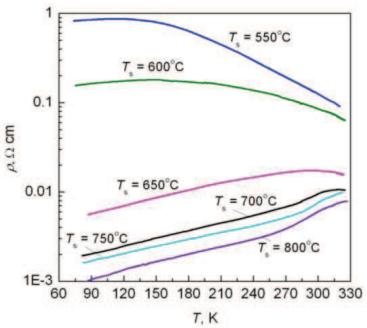
Resistivity ($\rho$) of the LSMO films grown at different substrate temperatures is shown in Fig. 1. The characteristic $\rho(T)$ curves with resistance peaks at $T=T_p>310$ K measured for the LSMO films (prepared at 700°C, 750°C and 800°C) are typical for the highest crystalline quality oxide material when grown on lattice-matched substrates. The highest values of negative magnetoresistance (MR =[R(B=0) – R(B=0.7 T)]/R(B = 0)) up to about 15% have been measured for the films at T=295K. At the same time, negligible MR values measured for the films at T=78K indicated absence of grain boundaries. In contrast, polycrystalline films with grain boundaries (when grown at 550°C and 600°C) demonstrated the highest MR values (up to 20%) at T=78K. It is important to note also that the film prepared at 650°C demonstrated significant MR values in a wide temperature range ($T=78 \div 295$ K). We conclude therefore that LSMO films of various crystalline quality and certain controllable electrical and magneoresistive properties may be grown on MgO substrates by applying dc magnetron sputtering and varying substrate temperature in the range 550°C -800°C.