
Molecular dynamics simulation is one of the most detailed molecular simulation methods for calculating the movement of each individual particle in a complex system. Newton's equations of motion along with periodic boundary conditions are solved for a very high number of particles in order to obtain information about systems' structural changes and the dynamic and thermodynamic properties. The advantage of this method is that it provides a detailed evolution of the chemical system in a cost effective manner. We have used MOLSIM software for molecular dynamics simulations in this work.
Classical molecular dynamics simulations of Na+, Li+, Mg+2, Al+3 and Cl- ions in aqueous solution were considered to investigate the distribution and dynamics of water molecules in the near-ions environment. In addition, we have studied the dependence of the structure of distribution of water molecules on the type of the applied force field. Two types of potentials were considered: (i) Coulomb's and Lennard-Jones and (ii) Coulomb's and Lennard-Jones polarizable potential. Following force fields for the water were selected: non-polarizable TIP3P [1], TIP4PEw [2], TIP5P [3] and polarizable Ahlstrom [4], POL3 [5] and modified Ahlstrom force fields.
During molecular dynamics simulations radial distribution functions and coordination numbers were computed. Simulated coordination numbers of Na+ and Li+ cations are in good agreement with experimental data. The coordination number of sodium is between 5-6. In lithium case, the water molecules of the first solvation layer tend to distribute in a tetrahedral shape, and the coordination number of Li+ is 4. The intensity of the first peak in radial distribution function depends on the choice of the force field, although radial distribution function is found to have similar shape in all cases, see Fig. 1.
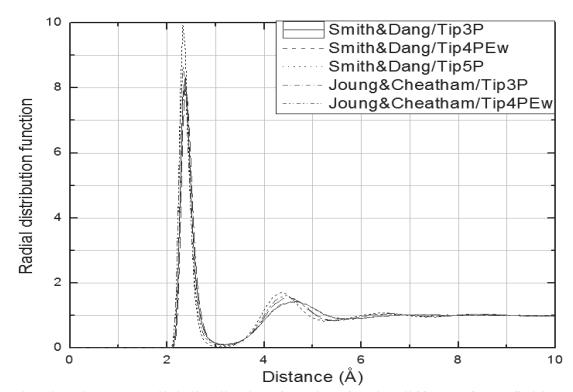
Distribution of water molecules is more structured in the cases of magnesium and aluminum than in the cases of monovalent Na+ and Li+ ions. This is due to the higher cationic charge. Water molecules in the solutions of Mg+2 and Al+3 migrate from the first solvation layer to the second (and vice versa) less frequently. Coordination numbers of both magnesium and aluminum were found to be 6. The best agreement with the experimental data for magnesium was obtained by using the TIP5P water potential of Allner et al. [6].
The coordination number of Cl- anion was found to be 6,7. It slightly varies depending on the chosen type of the force field.