
The Lévy $\alpha$-stable distributions, characterized by the index of stability $0 < \alpha \le 2$, constitute the most general class of stable processes. The Gaussian distribution is their special case, corresponding to $\alpha = 2$. If $\alpha < 2$, the Lévy distributions have power-law tails $\sim 1/x^{1+\alpha}$. There are many systems exhibiting Lévy $\alpha$-stable distributions: distribution function of turbulent magnetized plasma emitters and step-size distribution of photons in hot vapours of atoms have Lévy tails; theoretical models suggest that velocity distribution of particles in fractal turbulence is Lévy distribution [1] or at least has Lévy tails. If system behavior depends only on large noise fluctuations, such noise intensity distributions can by approximated by Lévy distribution, leading to Lévy flights. Lévy flights can be found in many physical systems: as an example we can point out anomalous diffusion of Na adatoms on solid Cu surface and anomalous diffusion in optical lattices. Lévy flights can be modeled by fractional Fokker-Planck equations or Langevin equations with Lévy noise.
One of the characteristics of the signal is the power spectral density (PSD). Signals having the PSD at low frequencies f of the form $S(f) \sim 1/f^{\beta}$ with $\beta$ close to 1 are commonly referred to as "1/f noise". Power-law distributions of spectra of signals with $0.5 < \beta < 1.5$, as well as scaling behavior are ubiquitous in physics and in many other fields. Despite the numerous models and theories proposed since its discovery, the subject of 1/f noise remains still open for new discoveries. The nonlinear stochastic differential equations generating signals with 1/f noise were obtained in Refs. [2], starting from the point process model of 1/f noise. Such nonlinear SDEs were used to describe signals in social systems. We generalized this nonlinear stochastic differential equations Eq. (2) by changing Gaussian noise into Lévy noise.
$$dx = a(x)dt+b(x)dL_t^{\alpha}, \tag{1}$$$$dx = \sigma^{\alpha}\gamma x^{\alpha(\eta-1)+1}dt + x^{\eta}dL_t^{\alpha}. \tag{2}$$Here x is a signal (velocity of diffusing particle) and $L^{\alpha}_t$ is $\alpha$ - stable Lévy process $(0 < \alpha \le 2)$. If $\alpha = 2$ it reduce to standard Wiener process (the Brownian motion). $\alpha$ is stability index of $\alpha$ - stable Lévy distribution, $\eta$ is multiplicativity of noise, $\sigma$ and $\gamma$ are normalization constants. We solved Eq. (2) by using numerical methods results are presented in Fig. 1. During calculations we restricted signal value in interval $x \in [x_{\min}, x_{\max}]$. The drift term a(x) in Eq. (2) represent subharmonic external force effecting particle. Lévy flights in subharmonic potentials lead to various interesting phenomena such as stochastic resonance in singe well potential. The power law dependence of diffusion coefficient $b^2(x)$ can be traced to existence of energy flux due temperature gradient in a bath. Long jumps, which leads to Lévy noise $dL^{\alpha}_t$, can arise from complex scale free structure of a bath as in the case of enzyme diffusion on an a polymer.
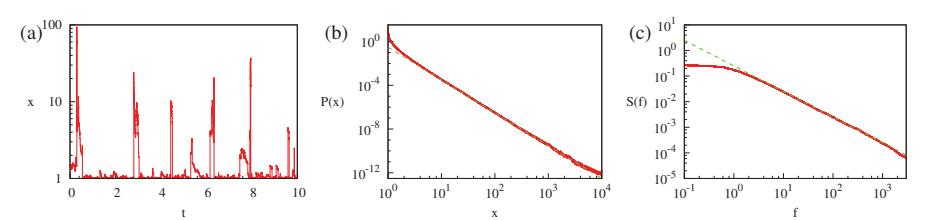
In conclusions, a class of nonlinear stochastic differential equations providing the power-law behavior of spectra, including 1/f noise, and the power-law distributions of the probability density has been analyzed. Usually such equations are driven by white Gaussian noise. We have generalized the nonlinear stochastic differential equations to be driven by Lévy noise instead of Gaussian noise. To preserve statistical properties of the generated signal we have changed the drift term in the equations. This model can be used to model Lévy flights in non-equilibrium and nonhomogeneous environments, like porous media and some cases of polymer chains. If specific conditions are satisfied our model generated Lévy flights which leads to 1/f noise.