
Organic semiconductors are very attractive for material research since they can be structurally manipulated by means of chemical engineering to achieve better performances in optoelectronic devices [1]. Triphenylamine (TPA) derivatives are widely investigated because of their excellent thermal and electrochemical stability, electron donating ability and optoelectronic properties. These properties are essential for solar cells fabrication. One of the most important factors in the operation of organic solar cells is exciton diffusion. Excitons are bound electron-hole pairs which are created in organic material by light absorption and need to be separated into free charges to generate photocurrent [1]. Thus, combining TPA with compounds exhibiting good electron accepting ability, such as naphthalimide, potentially could be applied for the fabrication of organic solar cells.
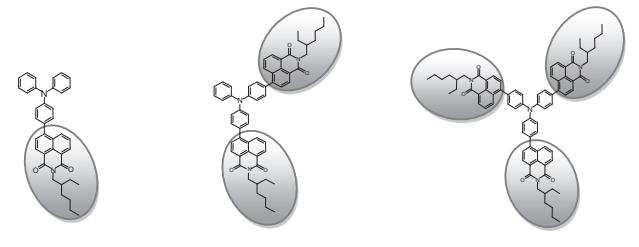
In this work, exciton diffusion length in the TPA-naphthalimide compounds bearing different number (from 1 to 3) of naphthalimide side-moieties was investigated (Fig. 1). The measurement of the exciton diffusion length was based on estimation of fluorescence lifetime of the TPA-naphthalimide compounds blended with various concentration of phenyl-C61-butyric acid methyl ester (PCBM) fluorescence quencher. Since oxygen acts as effective fluorescence quencher, films were prepared in nitrogen environment and encapsulated between two glass plates. Fluorescence kinetics of the TPA-naphthalimide:PCBM blends were estimated by time correlated single photon counting method and modeled with Monte Carlo simulation of 3D exciton hopping to estimate exciton diffusion coefficient [1].
The obtained results demonstrate that increasing number of naphthalimide side-moieties results in prolonged average fluorescence lifetime from 10 ns to 13 ns and enlarged exciton diffusion coefficient from $2.7 \cdot 10^{-6} \text{ cm}^2/\text{s}$ to $6.4 \cdot 10^{-6} \text{ cm}^2/\text{s}$. The enhancement of fluorescence lifetime and diffusion coefficient results in increase exciton diffusion length from 2.9 nm to 5.1 nm.
Tailoring of exciton diffusion length by introducing larger number of naphthalimide side-moieties might be applied in designing new compounds for the application in organic solar cells.