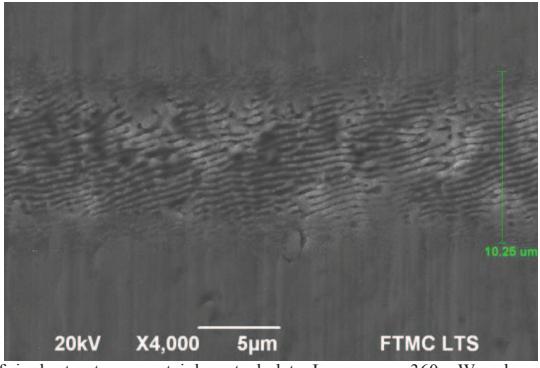
Laser induced periodic surfaces structures (LIPSS), also called ripples, have been observed on metallic surfaces at laser fluencies close to material ablation threshold. Ripple formation is attributed to the interference between the incident laser and the surface scattered light field. The periods of surface ripples are usually close to the laser wavelength $\lambda$ [1, 2].
Ripples change optical properties of a metal surface and therefore they can be applied to blacken the metals to achieve better light absorption, as well as they show a huge potential in solar energy and sensitive optical elements [3].
The formation of ripples depends on material properties as well as experimental parameters such as laser wavelength, pulse duration, pulse energy, overlap of the pulses, polarization etc.
In this work ripples were formed on a stainless steel surface using fiber laser (pulse duration 15 ps, pulse repetition rate 2 MHz) operating at 532 nm wavelength and samples were analyzed using scanning electron microscope (SEM). Optimal experimental conditions for ripple formation were found and the influence of experimental parameters on ripple morphology was studied.