
Vibrational spectroscopy method is a very useful tool to investigate pigments used on artworks [1]. In this study four samples of the painting were investigated by Raman spectroscopy method, because microchemical analysis did not give any answer to the question about the chemical structure of the pigments, which are on different sample layers. Micro-probed Raman spectra of the different layers of the samples were obtained by using Renishaw "InVia" Raman microscope through 20x objective of a "Leica microscope". The Raman spectra were excited by a 785.0 nm wavelength solid state laser with backscattering geometry. The laser power was 5 mW and integration time was 200 s. The Raman bands (Fig. 1.) of the pigment spectra were assigned using Raman spectra libraries [2, 3]. The pigments identified in this work are cinnabar, orpiment and red ochre.
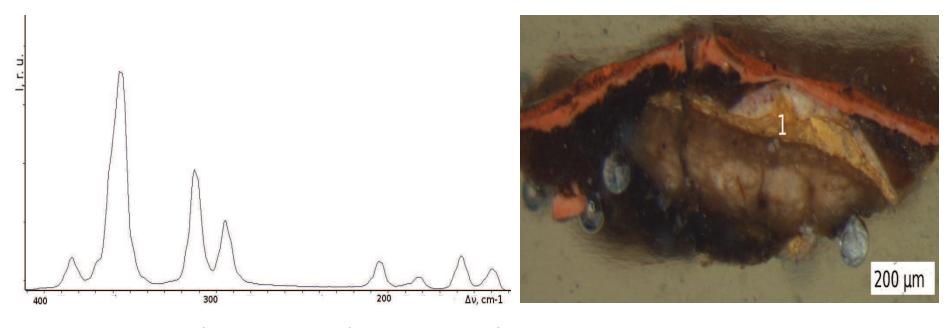
Investigation revealed that the yellow layer of sample 1 is orpiment (Fig. 1.) and the red layer is cinnabar. The red layer from sample 2 is red ochre.