FABRICATION OF POLYLACTIC ACID MICROSTRUCTURED SCAFFOLDS VIA 3D PRINTING
Laurynas Lukoševičius1, Mangirdas Malinauskas1
1 Department of Quantum Electronics, Vilnius University, Saulėtekio Ave. 9, Vilnius LT-10222, Lithuania
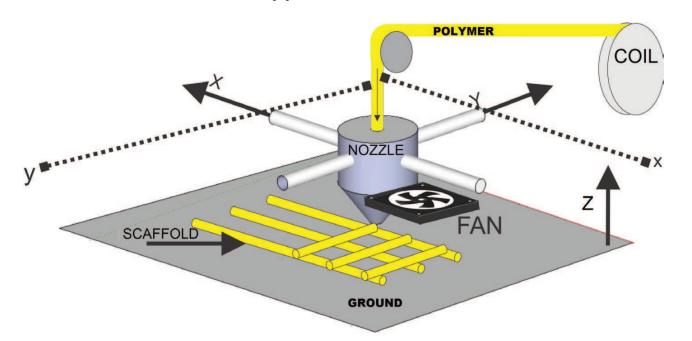
A thermal extrusion "Ultimaker Original" 3D printer (Fig. 1) – a simple, low-cost tabletop device enabling rapid materialization of CAD models in plastics – was used to produce scaffolds (Fig. 2A) with a microstructures out of polylactic acid (PLA). Features that distinguish PLA: biocompatibility, biodegradability, non-toxicity[1].
Fig. 1. Three-dimensional printer.
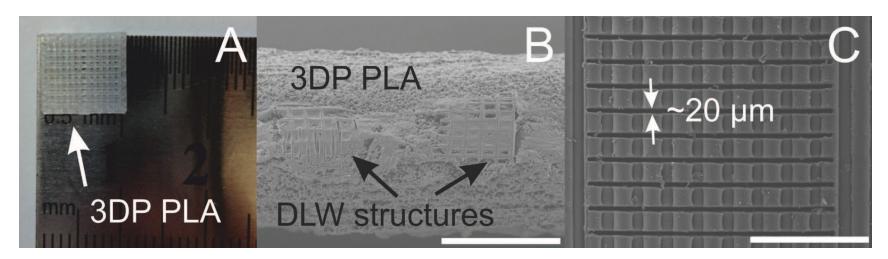
The direct laser writing (DLW) with femtosecond laser beam was used to modify the 3D printed (3DP) PLA surfaces (Fig. 2B,C). Different structure geometry on macro- to micro- scales could be finely tuned by combining these fabrication techniques for the reason that cells growth depends on the surface[2].
Fig. 2. 3DP microstructured objects: A – a 3DP woodpile scaffold of 1x1x0.1 cm3; B – DLW μ-grating structures on a log of 3DP woodpile structure as in A; C – 3D printed vertically wavy structures and horizontally ablated lines. Scale bars in B and C - 500 μm.
Such artificial 3D scaffolds could be used for cell growth or as biodegradable implants in tissue engineering. Investigation of cell proliferation and tissue formation on such artificial scaffolds (in vitro) and their implantation (in vivo) experiments are currently in progress[3].
[1] D.E. Henton, P. Gruber, J. Lunt and J. Randall "Polylactic Acid Technology", 429 (2005).
[2] L. Xiao, B. Wang, G. Yang, M. Gauthier, Poly(Lactic Acid)-Based Biomaterials:Synthesis, Modification and Applications, InTech (2012).
[3] E. Balčiūnas, L. Lukoševičius, D. Mackevičiūtė, S. Rėkštytė, V. Rutkūnas, D. Paipulas, K. Stankevičiūtė, D. Baltriukienė, V. Bukelskienė, A. P. Piskarskas and M. Malinauskas, "Combination of thermal extrusion printing and ultrafast laser fabrication for the manufacturing of 3D composite scaffolds", Proc. SPIE., in press (2014).