
The method of photodynamic therapy is a perspective method to diagnose and treatment of tumor diseases. This method requires special spectrometric equipment, giving stable and easily reproducible results, as well as special material for researching of the effects on biological tissues. As well as studies with living biological objects are costly and methodologically complex, it is necessary to use phantoms, i.e. an objects simulating certain optical properties of the biological tissue (for example: absorption and scattering coefficients, anisotropy, etc.). Currently using optical phantoms, which have equal optical properties with real tissues, have unique multilayer structure as usual, that makes its reproduction very difficult. If the phantom developed for the control and testing of some equipment, quality of its specifications can be substantially reduced. In that case it is enough for the fluorescent specters of the phantoms and biologic tissue preserved during sufficiently large time interval. This phantom can be called imitation measure.
The imaging spectrometric complex for the studying of fluorescence of various objects (biological tissues, securities etc.) was designed in Scientific Research Institute of Applied Physical Problems. The aim of our study was to develop imitation measures for the calibration of the complex. As imitation measures was decided to use cellulose base, which was applied a drop of polymethine dye (PD), which is room-temperature dried room temperature. The dye was selected with the fluorescence spectrum in the near-infrared region. To eliminate the influence of humidity in the laboratory was selected water-insoluble colorant. As the solvent, ethanol was selected. In that work was considered different spectral characteristics of the imitation measures at various concentrations of PD. The range of dye concentrations in which the intensity at the maximum of the fluorescence depends linearly on the concentration was detected. As shown in Figure 1, it was elucidated the linear dependence of the intensity maximum in the fluorescence spectrum of the exposure time in the photometer.
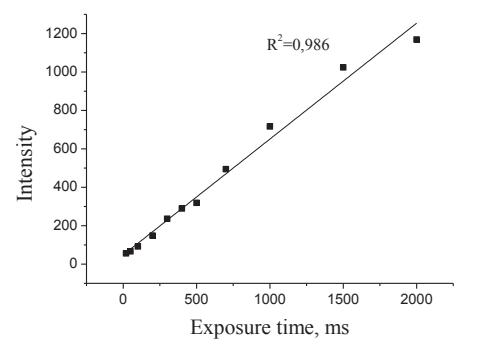
The possibility of doubling the concentration of the dye recoating on dry surface of the previous drop was analyzed. The uniformity of the dye spot on the imitation measure was investigated. Time period in which the properties of the phantom can be considered as constant (with the exclusion of light exposure) was determined. It is concluded that the developed phantom can be used for registration photosensitizer's concentration in tissues in vivo and control of parameters stability of the spectrometer.