Prions are infectious proteins capable of causing such diseases as “mad cow” disease in cattle and Creutzfeld-Jakob disease in humans. These fatal neurodegenerative disorders arise when normal cellular form of prion protein (PrPC) is converted into an aggregated, beta-sheet-rich isoform (PrPSc). One of the most surprising features of prions is their ability to self-replicate via the conversion of PrPC into disease-associated isoform. One of the possible mechanisms of prion structure replication is elongation of amyloid-like fibrils.
Here we tried to gain an insight into elongation kinetics and thermodynamics of murine prion protein fibrils under different environmental conditions: several guanidine hydrochloride (GuHCl) concentrations. Quiescent conditions were used in order to avoid most of nucleation processes (such as primary nucleation and fragmentation of fibrils).
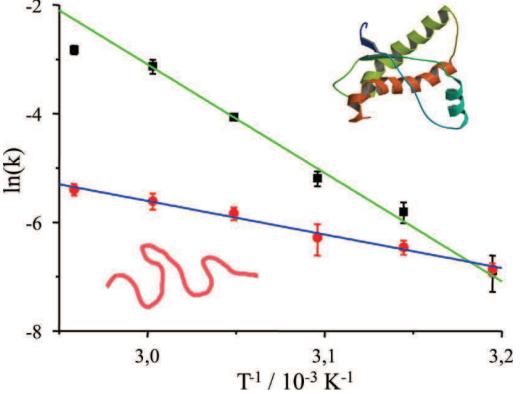
Using Arrhenius coordinates we were able to demonstrate differences in activation energies of fibril elongation when attaching folded versus unfolded PrP monomers (Fig. 1).