
The lead design in drug discovery is based on selecting the highest affinity compounds that bind to the target protein. However, compounds with similar affinities often have very different enthalpic and entropic contributions due to the enthalpy-entropy compensation phenomenon. The binding enthalpy primarily reflects the strength of the interactions of the ligand with the target protein (e.g. van der Waals, hydrogen bonds, etc.). The entropy change, on the other hand, mainly reflects two contributions: changes in conformational entropy and changes in solvation entropy [1].
Many binding reactions are coupled to the absorption or release of protons by the protein or the ligand. This phenomenon can be studied by detecting the heat effect produced by the protons exchanged between the protein and the buffer as a consequence of the inhibitor binding [2]. An investigation of the binding energetics requires the dissection of the buffer-related contributions, because only intrinsic parameters can be correlated with molecular structure and used for rational drug design.
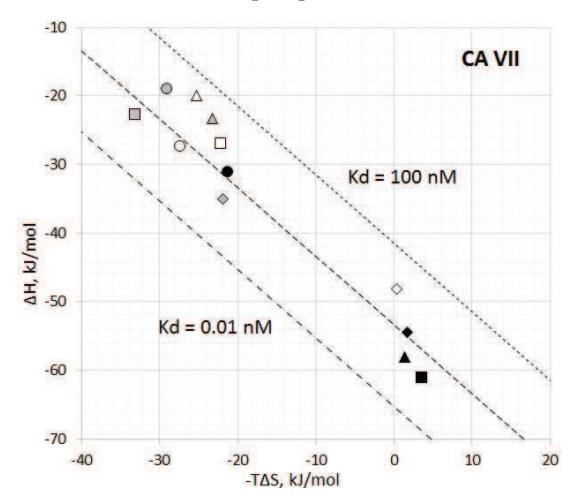
In this work [(2-pyrimidinylthio)acetyl]benzenesulfonamides were investigated as inhibitors of recombinant human carbonic anhydrase isozymes. Many of the carbonic anhydrase isozymes are important therapeutic targets to treat a range of disorders including glaucoma, obesity, epilepsy and cancer [3]. The binding affinity was determined using isothermal titration calorimetry and thermal shift assay. Isothermal titration calorimetry was also used to evaluate protonation/deprotonation coupling and contributions of $\Delta H$ and $\Delta S$ to the binding affinity. Compounds were mapped in the direction of increasing functional groups to correlate with the increments in the intrinsic thermodynamic parameters.