
Carbon nanotubes (CNTs) as one of the most perspective materials for future nanoelectronic devices have been acknowledged in the past decade. Unique electrical and optical properties of CNTs and them combination along with chemical functionalization by DNA promise a broad range of applications in medicine, molecular electronics and cancer therapy [1]. Some models of the DNA interaction with CNTs are known currently. Most popular model of the DNA wrapping around CNT by R. E. Smalley is proposed [2]. Wrapping of the DNA around of CNTs occurs when the aromatic hydrophobic DNA bases interact with the sidewall of the CNT via $\pi$-stacking.
In spite of existing mechanisms interpretation of complexing of DNA-CNT hybrids future progress in their studying is connected with methods subnanometer resolution on base of AFM.
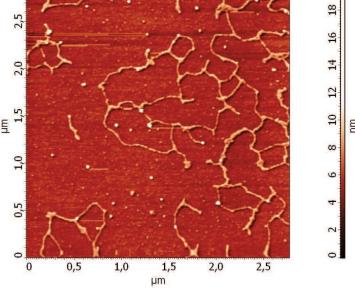
The AFM image of DNA adsorbed onto mica in Figure 1 shows that diameter of molecules DNA is 1.8±0.4 nm. That value agree with diameter of DNA in aqueous solution.
Application of AFM allows the direct observation of DNA wrapping around a CNT. Investigation of hybrid system DNA-CNT is shown in Figure 2 (a). Figure 2 (b) represents the CNT-DNA hybrid profile variations in the direction of DNA coiling. Regular height modulations of the DNA-covered segments of the CNTs are also visible in the image. Profile emphasize the periodic nature of these modulations along the nanotube.
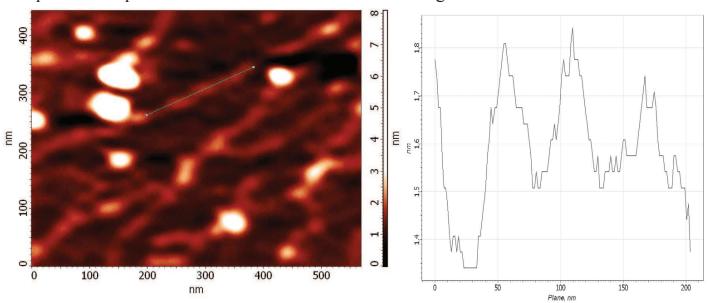
Imaging of CNT-DNA have been hybrid geometry with subnanometer resolution. Results of investigation allow draw a conclusion about periodically spiral wrapped of the DNA strand around the nanotube. Also has been defined that structure of DNA destabilized consisting of hybrid system DNA-CNT.