
Nanacomposite materials based on dielectrics containing metal nanoparticles formed by a random arrangement of inclusions in a matrix could be employed in the design of frequency-selective materials or EM absorbers with dimensions much smaller than those of conventional ones [1]. Laser ablation in liquids provides the new synthesis technique for the metallic nanoparticles, which can be employed in nanocomposite production by liquid deposition [2]. The nanocomposite synthesis procedure are investigated with the aim of microwave absorbers production.
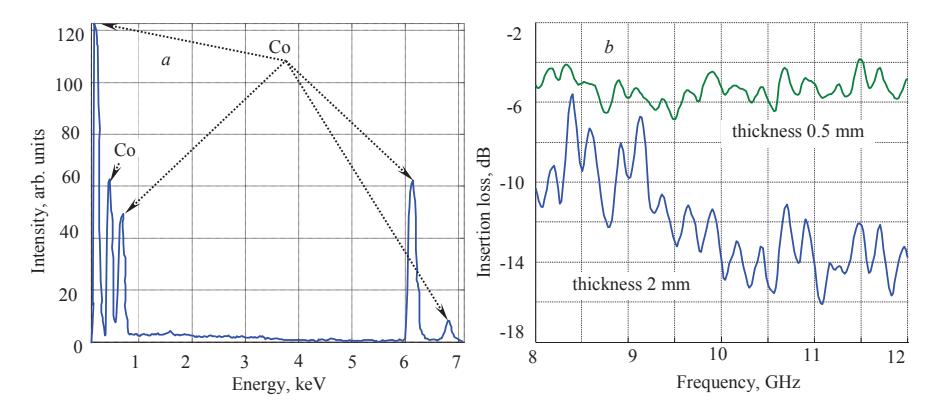
The aqueous colloidal solution of Co nanoparticles is prepared using Nd:YAG laser ablation setup from chemically homogeneous massive plate of cobalt [3]. The synthesis is performed under the laser wavelength of 1.06 μm, pulse duration of 20 ns, pulse repetition rate was 5 Hz and an average energy of 200 mJ. The optimal power density on the spot is found to be ~ 1 GW/cm2. Typical exposure time for the preparation of optically dense samples of metal colloids is chosen to be 10 min for one sample with the water volume of 120 ml. It important to note, that ablation process occurs in the air followed by nanoparticles sedimentation into the water. The samples of nanoparticles are studied by the transmission electron microscopy and characteristic radiation. Fig. 1 a shows the characteristic radiation spectrum, which correspond to metallic cobalt. The nanocomposite films are prepared by the deposition of the solution of the nanoparticles in the polymer matrix. At the final stage the nanocomposite contains polyvinyl alcohol matrix and cobalt nanoparticles.
The microwave performance of the obtained nanocomposite samples is investigated with vector network analyzer in the frequency range of 8 – 12 GHz. Fig. 1 b shows the insertion loss of the 0.5 mm and 2 mm thickness samples of nanocomposite. One can see the the spectrally flat insertion loss of the nanocomposites on amount of 4 –12 dB. This fact allows us to consider synthesized Co nanocomposite as microwave absorbers.
An advantage of the proposed nanocomposite synthesis procedure is simplicity of the of the production of the microwave absorbers. The developed technique can be used in the microwave shielding production in the specified frequency range.
The further investigations will be performed in the direction obtaining the frequency-selective microwave absorbing nanocomposite material.