
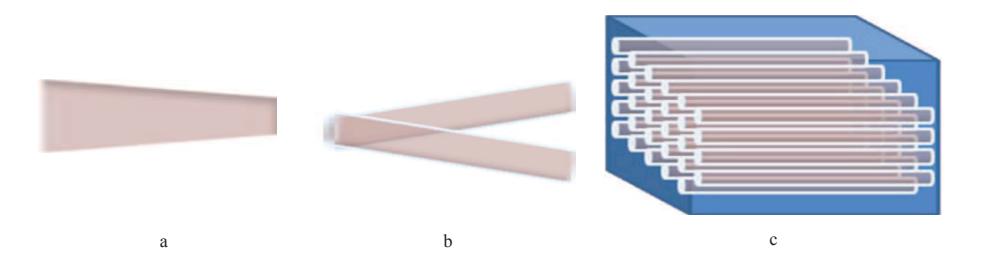
The study of spatial solitons in photorefractive crystals [1] has showed the possibility to guide light by light-induced refractive index changes at very low power levels [2-4]. The light creates a waveguide that guides itself or can guide other beams. In lithium niobate (LN), the self-induced waveguides have a lifetime of the order of $\sim$ 1 year, when guiding beams at wavelengths outside the photorefractive sensitivity range of the crystal. We demonstrated the robustness of these waveguides in guiding of IR ultrashort pulses (femtosecond) at very high peak powers [4, 6, 7]. Depending on the experimental conditions the waveguide's transversal and longitudinal refractive index distribution can take different shapes. This way we can generate different waveguiding elements of particular importance in integrated photonics applications like tapered waveguides, Y junctions or array of waveguides, as shown in Fig.1.
In the past years we have made significant improvements to the process of waveguides recording. We review our recent results regarding the recording of volume and surface self-induced waveguides in LN