
Ultrathin two-dimensional structure of layered transition metal dichalcogenides (TMDs) technologically simple to manufacture and effective in use. Structures consisting of one or several TMD layers are direct-gap semiconductors, its' value gap and charge carrier type varies depending on the crystallographic configuration, chemical composition and dimensions of the compounds. Thus, the possibility of modifying the electronic structure of TMD makes them attractive in a wide range of applications in micro-and nanoelectronics.
A dimensiality plays a crucial role in determining the basic electronic properties of TMD compounds in addition to its composition and crystallographic configuration of the atoms. The most outstanding example is graphene, the unique properties which are absent in bulk graphite [1 - 3]. The rapid pace of graphene study and developed of methodologies of thin layers obtaining led to the development of the other two-dimensional materials. In particular, the two-dimensional structures of TMD monolayers similar to that of graphene, have received considerable attention because of its large band gap value and naturally abundant [4].
Group-V TMD compounds are narrow-gap semiconductors or semimetals, characterized by low value of electrical resistivity (~ 10 - 6 Ohm ⋅ cm) and periodic redistribution of electronic, ionic and total charges (charge density wave) [5]. M - M bond length in MX2 structures (where M- group V transition metal, X – chalcogen) ranges from 3,15 Å to 4,03 Å, depending on the size of the metal, crystallographic configuration,and chalcogen ion. These values are 15-25% greater than the length of the bonds in the transition metals solids, indicating the limited energy and spatial overlap of d-orbitals in TMD compounds [6]. Crystallographic configuration of M metal in TMD structure can be trigonal prismatic (D3h) or trigonal antiprismatic (D3d) (Fig. 1).
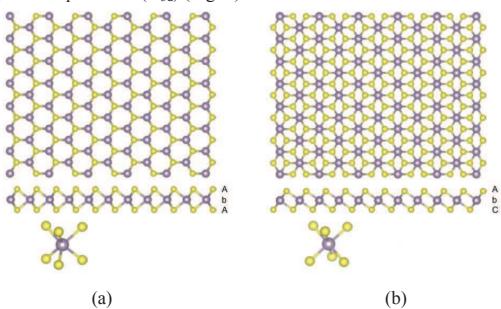
The diversity of physical and chemical composition quasi-two-dimensional TMD structures provides many opportunities for the use of its' electronic and magnetic properties in a wide range of applications for micro- and nanoelectronics, particularly for energy storage devices, the catalytically active elements in optoelectronics, and structural components for microelectronic devices. However, key challenges remain associated with an increase of electrical conductivity and increase of two-dimensional structure stability, the solution of which requires integration of experimental and theoretical studies.