
Hematoporphyrin is a clinically approved photosensitizer of a first generation widely used in photodynamic therapy. A photosensitizer is a light-sensitive compound, which transfers the excitation energy to surrounding molecules inducing photochemical reactions and causing cellular damage. However, hematoporphyrin is unstable and its exposure to light leads to both photodegradation and phototransformation of porphyrin molecules [1].
Phototransformation studies are important to determine the photochemical activity of the photosensitizer. The formation of photoproducts also indicates the biological activity of photosensitizer proving a possibility of its application for diagnostics. However, the photochemical activity of photosensitizers is also affected by the amount of oxygen and acidity of the medium [2].
In some in vivo cases solid tumors possess oxygen-poor areas [3]. In these conditions the efficiency of photodynamic therapy (PDT) is limited. The goal of this study is to search for alternative methods to enhance the effect of PDT in such medium.
Using steady state methods of spectroscopy, photo-induced spectral changes were followed by comparing absorption and fluorescence spectra of hematoporphyrin in phosphate buffer solutions (C= 10-4 mol/l) without or with added ascorbic acid, which is a water soluble antioxidant (concentrations up to 20 mmol/l). Absorption spectra (Fig. 1) were measured using a spectrophotometer AvaSpec-3648 (Avantes, The Netherlands), fluorescence spectra were measured using a fluorometer LS55 (PerkinElmer Inc., USA) in 1 cm quartz cuvettes.
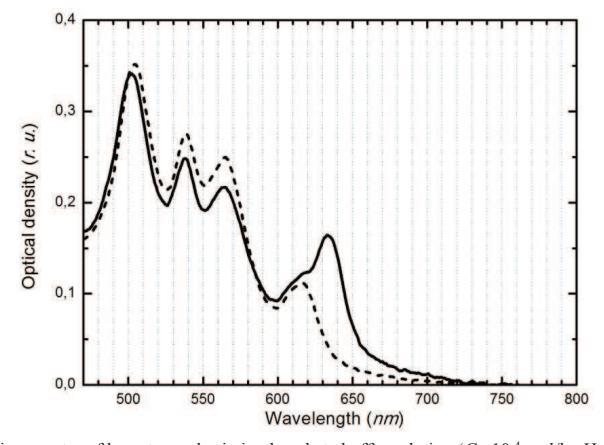
In normal conditions antioxidant acts by neutralizing reactive oxygen species, whereas protecting photosensitizer from auto-oxidation. Therefore, samples were irradiated by means of a diode pumped solid-state laser ($\lambda$= 532 nm) at different intensities seeking for a critical value of irradiation intensity, at which a lack of oxygen in solution is created. Since in oxygen-poor medium photosensitizing activity of hematoporphyrin becomes greatly reduced, further spectral changes emerge mainly because of interaction of photosensitizer with antioxidant. It has been found that under such conditions ascorbic acid provoked a new phototransformation pathway of hematoporphyrin.