
It is necessary to know the dispersion characteristics of optical components in laser systems in order to obtain bandwidth-limited femtosecond pulses. To compensate the normal dispersion in femtosecond laser systems chirped mirrors are usually used. Those chirped mirrors have multilayer dielectric coatings, which modulate the phase of the reflected pulse [1]. Production of such mirrors is a complicated technological process, consequently the produced mirrors have different characteristics from designed ones. The aim of this project is to create an interferometer system to measure the dispersal characteristics of those chirped mirrors.
White light interferometry is one of the simplest ways to measure the dispersion of different materials [2]. In this project we used a Michelson interferometer and a broadband white light continuum source pumped by Q-switched microlaser. The whole optical setup is presented in Fig. 1(a).
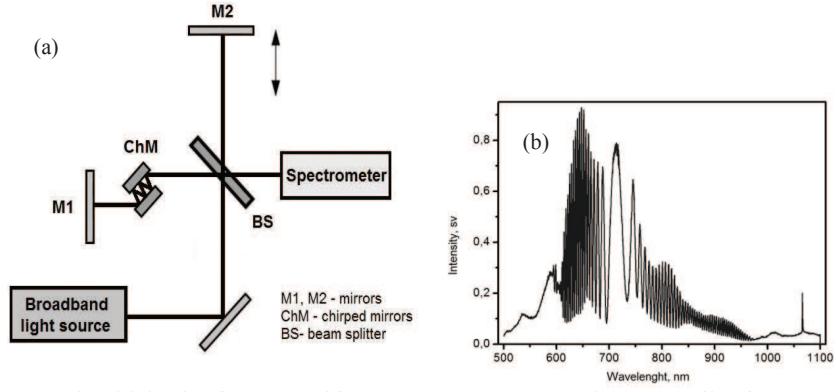
The laser beam is divided by a 3μm thickness beam splitter (BS). One of the beams is transmitted through the beam splitter and reflected at the mirror M2, which is placed on a motorized delay line.
The second beam goes through the pair of chirped mirrors and is reflected 4-8 times from each mirror, depending on the angle of incidence. Afterwards, the beam is reflected at mirror M1 and comes back to the beam splitter. Beams from different arms of the interferometer are combined and sent to the spectrometer, where the interference spectrogram is measured (see Fig. 1(b)).
In a spectrogram, the zero order interference fringe is observed. The motion of the delay line changes the position of the zero order interference fringe. Identifying how the central wavelength $\lambda_c$ of the zero order interference fringe depends on the induced delay leads to finding the group delay dispersion [3].
In this project, the characteristics of two types of chirped mirrors with negative and positive group delay dispersion were measured and compared with the data provided by the manufacturer.