
Multi-photon laser polymerization is an attractive direct laser writing (DLW) technique for micro-/ nanostructuring. This method allows fabrication of complex 2D and 3D objects with sub-diffraction resolution. A tightly focused ultrafast pulsed laser beam induces photopolymerization in the volume of the photosensitive material. By translating the sample, the position of the focal spot is changed, thus point-by-point structures can be written inside the material [1]. Promising applications have already been demonstrated in microopics, microfluidics, photonics and biomedicine.
Laser polymerization can be applied for production of artificial scaffolds on which cells could controllably grow and form tissues required in tissue engineering and regenerative medicine [2]. To achieve this, it is important to mimic the composition and structure of the natural tissues. Chemical and geometrical properties of the scaffolds play an important role in regulating cell migration, proliferation and differentiation. Laser polymerization opens a way to produce structures with desired geometry, pore size or porosity from a variety of different materials [3]. Such composite constructions provide not one but several desired biological spatially located features including biostability, biocompatibility or biodegradation.
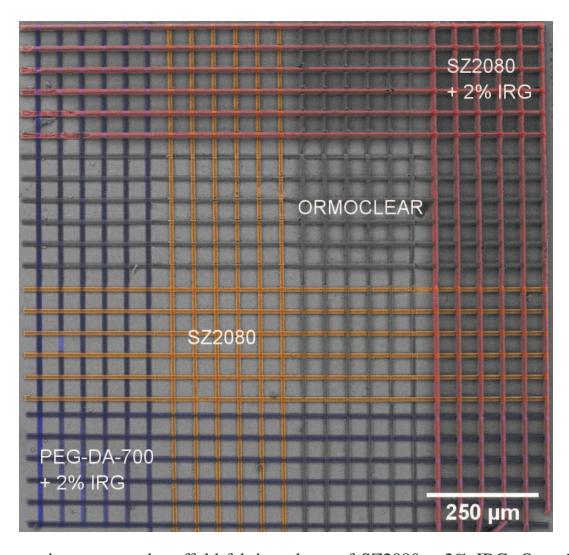
In this work we demonstrate the capability to fabricate microstructured multi-component scaffolds consisting out of four polymeric materials: organic-inorganic hybrids OrmoClear, SZ2080 non-sensitized and photosensitized with 2% 2-benzyl-2-(dimethylamino)-4'-morpholinobutyrophenone (IRG) and biodegradable PEG-DA-700 + 2% IRG (Fig. 1).