
Crystalline GaN is a promising material for manufacturing of the radiation hard particle detectors capable to operate in harsh areas of particle accelerators [1]-[4]. Moreover, GaN crystals show rather efficient luminescence properties under excitation by high energy radiation [5]–[7]. Thereby, GaN material can be utilized for fabrication of the combined device which is able to operate both as scintillating and charge collecting detector. However, efficiency of such detectors and their functionality is investigated insufficiently.
This work is addressed to study of the efficiency of proton induced steady-state photoluminescence. To evaluate the density of the high energy proton induced excess carriers, the correlation between the microwave probed photoconductivity (MW-PC) transients and the proton induced luminescence (PI-L) intensity has been examined. The proton energy range (1.6 MeV) has been chosen to implement the nearly homogeneous and rather strong excitation of the 2.5 μm thick GaN epi-layers. To estimate radiation hardness of such material, evolution of MW-PC and PI-L characteristics has been studied by the in situ measurements of the changes of PI-L intensity and MW-PC decay rate during exposure to a proton beam reaching fluences up to 1015 cm-2.
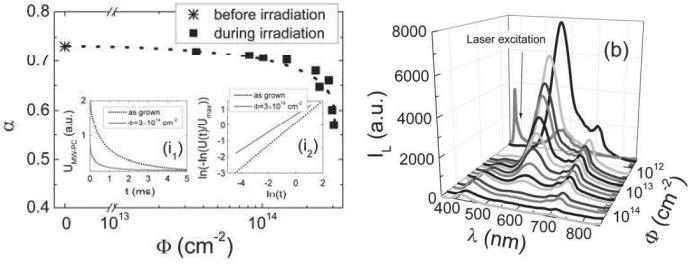
The 2.5 μm thick GaN epi-layers [3]–[5], [8] grown by metal-organic chemical vapour deposition (MOCVD) technique on sapphire substrate have been examined. Dislocation density in these epi-layers was evaluated to be of about 1010 cm-2.
Comparison of luminescence spectra induced by proton beam and by a laser pulse enabled us to evaluate the efficiency of carrier pair generation, - being of $1\times10^7$ cm-3 per 1.6 MeV proton, and 40 carrier pairs per micrometer of layer depth. This result indicates that GaN layers can be an efficient material for detection of particle flows. It has been demonstrated that GaN material can also be a rather efficient scintillating material within several wavelength ranges.