
High efficiency light-emitting diodes based on the wide-band-gap nitrides such as InGaN or AlGaN recently gained a lot of interest. Although AlGaN has a great potential in UV optoelectronics, there are a lot of experimental results demonstrating the undesirable decrease of quantum efficiency at high excitation density [1]. This effect called "efficiency droop" and yet is not fully understood. In this paper, we investigate the behavior of the dynamics of the photoluminescence (PL) by the theoretical calculation of the PL spectrum and comparison with the experimental data in AlGaN quantum wells.
The theoretical model of the PL is based on the band-to-band recombination with intensity:
$$I_{\rm L}(E) = K \frac{g(E)f(E)\tau_{\rm PL}(E)}{\tau_{\rm L}} \tag{1}$$where $E$ is a photon energy, $g(E)$ is a density of states, $f(E)$ is a Fermi-Dirac distribution function, $\tau_{\rm PL}(E)$ is an energy-dependant PL life time, and $\tau_{\rm r}$ is a radiative recombination time of nonequilibrium carriers.
Nitride-based quantum structures, especially with higher Al concentration have a nonhomogeneous distribution of the AlGaN content which leads to considerable gap energy fluctuations and as a result formation of the localized states [2]. We use the Gaussian distribution model of the localized states. Thus, the density-of-states function becomes:
$$g(E) = \int_{0}^{\infty} \frac{m_{e}^{*}}{\pi \hbar^{2}} \sum_{i=1} \Theta\left(\widetilde{E} - E_{g} - \frac{\hbar^{2} n^{2}}{2m_{e}^{*} d^{2}}\right) \cdot \frac{1}{\sqrt{2\pi}\sigma_{h}} \exp\left(\frac{(E - \widetilde{E})^{2}}{2\sigma_{h}^{2}}\right) d\widetilde{E} \tag{2}$$The localization of the carriers in potential wells due to potential fluctuations leads to longer PL life time in the corresponding photon energy region, while carriers with higher energy above the mobility edge have higher probability to find and recombine nonradiatively via corresponding centers. The latter process leads to the decrease of the PL life time for higher photon energy. In this model, we apply the empirical formula extracted from experiment for describing $\tau_{\rm PL}$ dependence on energy as follows:
$$\tau_{\rm PL}(E) = \frac{\tau_{\rm r}}{1 + \exp\left(\frac{E - E_{\rm me}}{E_{0}}\right)} \tag{3}$$The calculated PL spectra and their comparison with experiment are illustrated in Fig. 1.
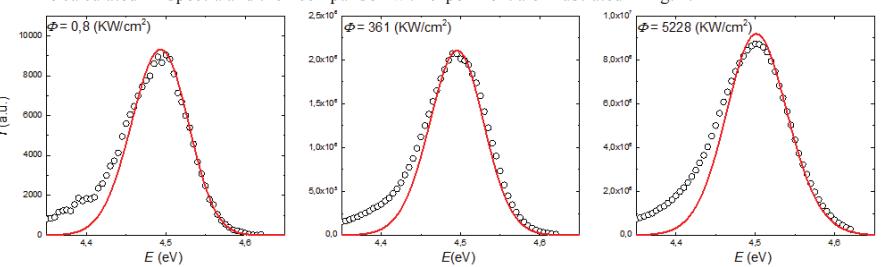
In conclusion, by taking into account the localized states distribution and the energy-dependant PL life time it is possible to achieve rather good coincidence of the experimental and theoretical PL spectra at various excitations. The "efficiency droop" is discussed in the frame of the proposed model.