This work shows the surface-enhanced Raman scattering for mercury sulphide microcrystals with two types of substrates. The first one were Si/Ge-nanostructures prepared by a chemical vapor deposition [1]. Afterwards gold nanoparticles were deposited on the Si/Ge-nanostructures surface. Substrates repared are three-dimensional arrays of coherently strained islands with a base of 200 nm and a height to 50 nm.
The second one was the gel-film of Ag nanoparticles on the glass. Silver sol was prepared by reduction of silver nitrate with sodium citrate as described in [2]. Polydispersed silver sol formed, average particle size is about 50 nm.
A He-Ne laser (632.8 nm) was used to excite the Raman spectra. Registration spectrum occured range 200-800 cm-1. For Raman measurments exposure time was 10 s.
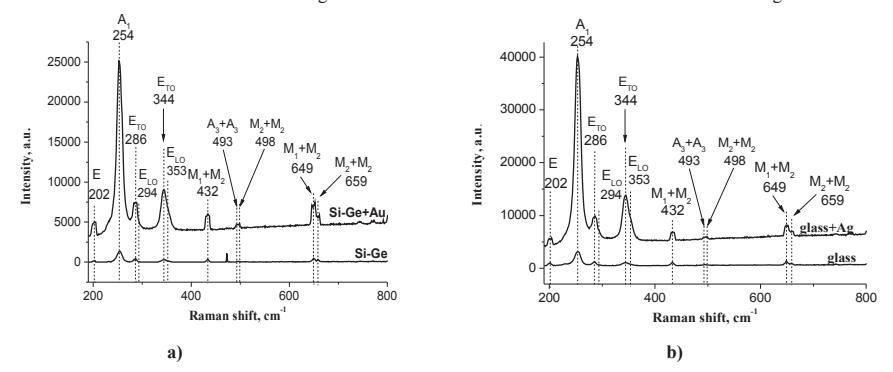
Raman spectra for the mercury sulfide microcrystals on the glass surface and the silicon-germanium substrate are shown in (Fig. 1). We can see symmetric band A1 about 254 cm-1, the transverse bands E(TO) at 286 and 344 cm-1, a band at 202 cm-1 and the secondary bands about 432, 650, and 659 cm-1, which are represented by the combined modes of the phonon oscillations M1 + M1, M1 + M2 and M2 + M2, respectively [3].
We can see selectively increasing intensity of the bands mentioned above in cases of using the substrates for surface-enhanced Raman scattering spectra. Also several new bands appear: the longitudinal E(LO) oscillations appear at 294 cm-1 (in the form of a shoulder at 286 cm-1 ) and 353 cm-1 ( in the form of a shoulder at 344 cm-1 ) and the second order band A3 + A3 and M2 + M2 at 493 cm-1, and 498 cm-1, respectively. The maximum gain in both cases is for the band 344 cm-1: 15.9 for the silicon-germanium substrate and 14.6 for the substrate with a silver gel-film.