Optical parametric oscillators (OPO) are unique devices providing coherent radiation tunable in a wide spectral region. Femtosecond optical parametric oscillators provide femtosecond laser pulses used for investigation of various ultrafast processes in spectroscopy, material science, biochemistry, etc. In order to generate low energy and high repetition rate tunable femtosecond pulses (which are prefered in the aforementioned applications), synchronously pumped optical parametric oscillator (SPOPO) is constructed. Synchronous pumping means that the generated pulse resonator round-trip time is equal to pump pulse repetition period [1]. This technique is implemented adjusting the SPOPO resonator length according to the aforementioned condition. Nowadays, most femtosecond SPOPOs use Ti:sapphire lasers as pump sources [2]. We seek to create and optimize SPOPOs pumped by mode-locked Yb:KGW "PHAROS" oscillators. Such laser and SPOPO systems should be cheaper, more compact and therefore competitive with Ti:sapphire pumped SPOPOs.
In this study we present experimental data obtained during the investigation of SPOPO pumped by the second harmonic (${\lambda}$=515 nm) of Yb:KGW "PHAROS" oscillator providing ~105 fs pulses at 76 MHz repetition rate with average output power of 1,71 W. At this stage of our research we constructed a folded cavity SPOPO mounted on a separate optical board. Such scheme is compact, can be moved and will be used as an experimental prototype for future SPOPOs. In this SPOPO the nonlinear medium for parametric generation was a 2 mm ${\beta}$-barium borate (BBO) crystal cut at ${\theta}$=22,2°and ${\varphi}$=90° for type I interaction and AR coated for pump (${\lambda}$=515 nm) and signal wave radiation (630 nm – 1030 nm). During parametric generation process two lower frequency waves (called signal and idler) are generated. Their wavelengths are defined by the energy (Eq. 1) and momentum (Eq. 2) conservation laws [3]. We constructed a singly resonant SPOPO, therefore the resonator mirrors were highly reflecting only at one of the generated waves (the signal wave in this case).
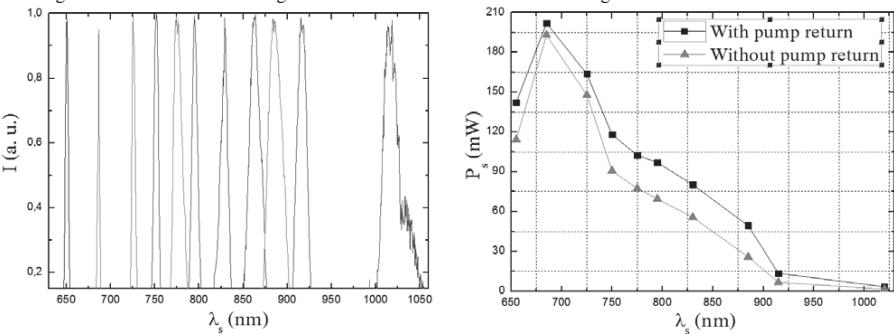
$$\frac{1}{\lambda_p} = \frac{1}{\lambda_s} + \frac{1}{\lambda_i} \tag{1}$$ $$n_p w_p = n_s w_s + n_i w_i \tag{2}$$We measured various SPOPO parameters with and without pump return using intracavity dispersion compensation and without it. We achieved signal wave tuning in 650 nm - 1030 nm range without intracavity dispersion compensation (Fig. 1 left) by rotating the BBO crystal and adjusting the SPOPO resonator length. Maximum output power varied from 202 mW at ${\lambda}$=685 nm to 3 mW at ${\lambda}$=1030 nm (Fig. 1 right). Such output power variations were caused mainly by these wavelength dependent factors: signal and idler photon energy ratio, pump and signal wave group velocity mismatch and cavity loss. We also measured output power dependence on pump power at different wavelengths and determined SPOPO generation thresholds for different wavelengths.