APPLICATIONS OF HIGH-POWER LIGHT-EMITTING DIODES FOR SOLAR SIMULATORS
Artūras Baguckis1, Algirdas Novičkovas1, 2, Algirdas Mekys1, 2, Vincas Tamošiūnas1, 3
1 Faculty of Physics, Vilnius University, Saulėtekio al. 9, Bldg. III, LT-10222 Vilnius, Lithuania
2 Institute of Applied Research, Vilnius University, Saulėtekio al. 9, Bldg. III, LT-10222 Vilnius, Lithuania
3 Center for Physical Sciences and Technology, A. Goštauto g. 11, LT-01108 Vilnius, Lithuania
Solar simulators are devices that provide illumination for the controllable indoor testing of solar cells. Their primary purpose is to simulate so-called AM1.5G standardized conditions. Several types of light sources are used for solar simulators and the most common ones today are xenon arc lamps. This is due to their good match of the spectrum of the Sun and the ability to filter with ease the emitted light to meet A class criteria, defined in the international standard [1]. Such lamps, however, have the disadvantage of low luminous efficiency, high power consumption, decrease in performance quality with aging, complex control and thermal management issues.
In comparison with traditional lamps, light-emitting diodes (LEDs) have numerous advantages, such as high efficiency, lower thermal emission, long lifetime, low operating voltage, etc. Recently, 1.5W light emitting diodes were applied to simulate solar radiation with 90% of the required by the standard intensity [2]. Also, a hybrid light source with B class spectral match was demonstrated [3].
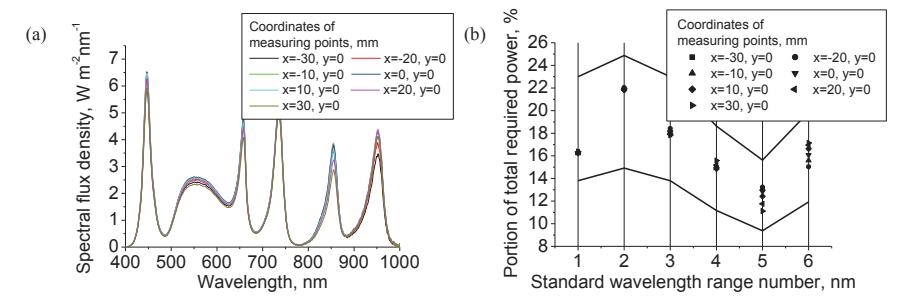
Fig. 1. Spectral irradiance distributions at 7 points of the test plane (a). Integrated spectral irradiance ratios to the total irradiance for six wavelengths intervals (every 100 nm between 400 nm and 900 nm and 900 – 1100nm) at 7 points of the test plane (b). Horizontal lines indicate upper and lower limits for A-class spectral match.
On this presentation, we report on the design and characterization of a solar simulator prototype based on high-power light-emitting diodes as light sources. Our goal is to demonstrate that compact array of only six types of LEDs (cool white, royal blue, deep red, far red and two types of infrared) can be sufficient for simulation of high (at least 100 mW/cm2) light flux density (see Fig. 1) with A-class spectral distribution match and A-class irradiance non-uniformity for the test area of several cm2.
Acknowledgments: This study was supported by the Research Council of Lithuania (Grant No. MIP-099/2012). In addition, A.Baguckis would like to acknowledge support by project "Promotion of Student Scientific Activities" (VP1-3.1-ŠMM-01-V-02-003) from the Research Council of Lithuania. This project is funded by the Republic of Lithuania and European Social Fund under the 2007-2013 Human Resources Development Operational Programme's priority 3.
[1] International Electrotechnical Commission standard IEC 60904-9 Ed. 2.0.
[2] Jang, S.H., and Shin, M.W.: 'Fabrication and thermal optimization of LED solar cell simulator', Curr. Appl. Phys., 2010, 10, pp. S537-S539.
[3] Bliss, M., Betts, T.R., and Gottschalg, R.: 'An LED-based photovoltaic measurement system with variable spectrum and flash speed', Solar Energy Materials & Solar Cells, 2009, 93, pp. 825–830.