Scanning highly-resolved 3D microscopy is widely used in engineering, biological and medical sciences [1]. One of the trends in its development is associated with the ways to obviate the mechanical movement of the optical elements during in-volume scanning of the object. The use of multiplex volume phase holograms characterized by high diffraction efficiency looks very promising for 3D microscopy with a stationary optics. In this way numerous cross-section measurements of one 3D image can be obtained by a single measurement resulting in faster data acquisition. The main idea of the use of volume multiplexing holography is that each of the superimposed holograms provides an image of one of the cross-sections of an object which has been obtained at a specific distance from the objective. Images of the cross-sections at different depths can be multiplexed to different adjacent detectors. They can simultaneously be recorded by a single measurement. For each such detector channel, a multiplexed hologram in the photopolymer is required.
The possibility to use multiplex phase holograms recorded in photopolymer layers is provided by their stability, robustness and long lifetime. The holographic material consists of the polymer (Polymethyl methacrylate), PMMA) and a photosensitive dye phenanthrenequinone (PQ). This novel material allows to record holographic gratings with high diffraction efficiency (DE is up to 90 %) due to the diffusion-based thermal amplification process [2-3].
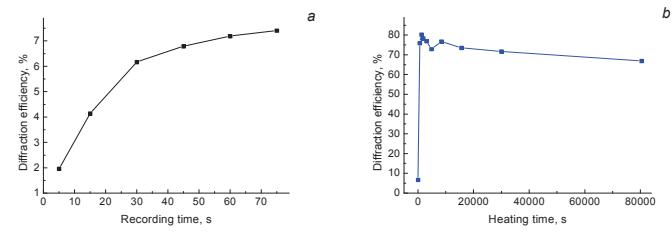
During presented study the record of the multiplex holograms of two point sources that are situated on the different distances from the objective lens on the optical axis was performed. Maximum DE during the record of a single grating achieved the values of about 7 %. After post-exposure annealing the DE increased up to 82 % (Figure 1 (a) and (b)).
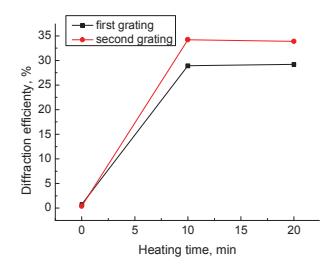
The kinetics of the diffraction efficiency of the first and second gratings during the multiplex record is presented in the Figure 2. The post-exposure annealing allows to increase the DE values up to 34 % and 26 % for first and second gratings, respectively.