
The availability and range of ultrafast (sub-picosecond) laser applications is spreading rapidly. In addition to scientific research, ultrashort laser pulses are now widely used in many areas, including industrial material processing and medicine [1]. When combined with nonlinear frequency converters, solid-state femtosecond laser systems provide ultrashort pulses in the UV spectral range, which makes them an advantageous tool for precise microfabrication of materials with high heat conductivity (e.g. metals, semiconductors). In such materials, UV pulses are absorbed significantly stronger than near-infrared or visible radiation. The deposited pulse energy is concentrated at the very surface and, consequently, material can be ablated with minimal collateral damage. High beam quality ($M^{2} \approx 1$) of the solid-state laser equipped with UV converters ensures small ablating spot size, hence, spatially precise high-quality micromachining. There are also several serious limitations or extensive industrial application of femtosecond UV nonlinear frequency converters operating at high pulse repetition rates. Due to high peak intensities of UV pulses, two-photon absorption becomes significant in glasses and crystalline materials [2, 3] causing thermal-lensing effects in transmitting optical elements (lenses, windows, beamsplitters, etc.). Therefore, both spatial and temporal output characteristics of the converter can deteriorate significantly.
In this work we study the thermal effects in the fourth harmonic generator of 1026 nm Yb:KGW laser operating at multi-kilohertz repetition rates. Start-up dynamics of the frequency converter was investigated and linked to the temperature effects in the fourth harmonic generation crystal. Mathematical model for the simulation of the fourth harmonic power and crystal temperature dynamics at the different crystal tilt angles was developed. The simulated results were compared with the experimentally measured data (Fig. 1).
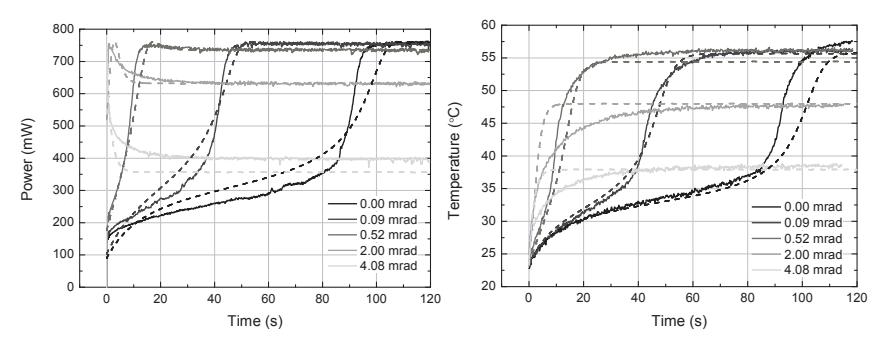
After switching laser radiation on transitional power grow at the output of the femtosecond high pulse repetition rate UV harmonic generator is quite slow (from a few tens of seconds to several minutes). Therefore motorized control of the tilt angles of nonlinear optical crystals can be applied to counterbalance heating induced transitional power change at the output of the UV harmonic generator by changing phase matching conditions over time. We demonstrated, that the steep start-up power grow can be achieved by changing the crystal tilt angle in an exponential manner accordingly to the measured output power dynamics. Also, motorized angular tuning can be applied to improve stability of the UV output power during variation of the duty cycle.