
Various glasses act as important engineering materials for different applications. The quality and efficiency of processing these materials are becoming crucial. Conventional methods of drilling or cutting glass by using diamond tools cannot ensure the increased requirements of manufacturers.
Over the last years many laser processing technologies have been patented and it is an emerging scientific and industrial trend. Short-pulse laser machining of glass offers a non-contact method, high accuracy, localized material removal, reduced thermal effects and cracks formation [1]. The laser and transparent materials interaction strongly depends on laser pulse duration. High intensity laser radiation is absorbed in the bulk of transparent materials by optical breakdown via multiphoton or avalanche ionization [2, 3].
In this work we carried out the series of experiments of helical drilling in silicate glass. In these experiments helical drilling was initiated from the back side of the glass plate. Initially laser beam was focused between the positioning stage and the sample back surface and the focal position was being moved in the volume of glass towards the front surface by constant speed.
Glass drilling experiments were carried out by using the fundamental harmonic of nanosecond Q-switched diode pumped solid state Nd:YVO4 laser (Baltic HP, 1064 nm, 13.3 W, 10-20 ns, 10-100 kHz, from Ekspla). The laser beam was positioned in the XY plane by the galvanometer scanner (SCANgine 14, ScanLab) and focused by the f-theta lens with the focal length of 80 mm. Samples were positioned in the vertical axis by moving stage with a stepper motor (8MT167-100, Standa). The galvanometer scanner, laser and positioning stage were synchronized to start and finish the drilling process at the same time.
Arrays of holes were drilled in the soda-lime glass plate with the thickness of 4 mm. The quality of drilled holes was evaluated by an optical microscope. The zone of glass chirps and surface cracks were measured for a number of holes drilled by different sets of parameters. Scanning speed in the XY plane, spiral scanning amplitude and frequency, laser power, repetition rate and vertical speed were changed while carrying out experiments. The regimes with the maximum processing speed were found for various laser power and pulse energy (Fig. 1).
The quality of drilled holes depended on laser power, the overlap of laser pulses and vertical speed. It was possible to drill a hole of 1 mm diameter in the 4 mm thick soda-lime glass plate per 1.2 s but the high quality holes required longer processing time. The quality was higher at the rear side of the processed glass surface.
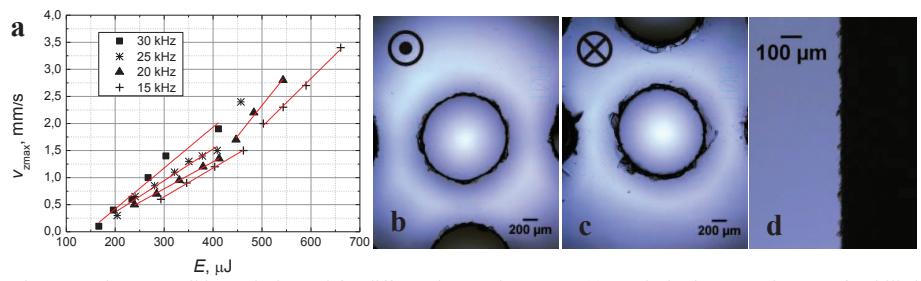
In conclusion, 1064 nm nanosecond laser radiation is suitable for rapid and efficient helical drilling in soda-lime glass, initiating the process from the backside and moving the focal position towards the front surface of the glass plate. Drilling debris is effectively removed through the drilled channel and does not scatter the laser radiation so we keep the constant density of laser power and it is possible to drill high aspect ratio holes with high perpendicularity of walls.