
Quantum dots (QDs) – semiconductor particles of nanometer-size – are promising fluorescent markers. In comparison with organic dyes and fluorescent proteins, QDs have a narrow and tunable emission band, broad absorption and sharp emission spectra, high brightness, enhanced photostability, resistance to chemical degradation and photobleaching [1]. The research on QDs is important in order to provide safe and effective biosensing materials for medicine [2].
In this study, absorption, steady state spectroscopy and microscopy measurements were performed on CdSe (518 nm) quantum dots in biological model environment. Stability, photostability, toxicity and spectral properties of quantum dots were investigated in the presence of Scenedesmus microalgae to reveal the effects of QDs interaction with biological system.
Aqueous media induced a time related blue shift of the photoluminescence band of quantum dots from 518 nm to 380 nm, but this shift was not observed in media with microalgae (Fig. 1a). Photoluminescence intensity of QDs was more stable in media with microalgae than in aqueous media. The same effect was reported in studies on QDs interaction with proteins [3]. That could be explained by formation of a new coating layer having a protective effect against degradation of quantum dots.
Samples of QDs in aqueous media and in media with algae were exposed to the blue diode light for an hour (405 nm, 90 mW/cm2) to measure photostability. Photoluminescence intensity of QDs decreased, and spectra shifted towards shorter wavelenghts after lighting. However, the exposure only accelerated the changes in CdSe QDs structure induced by aqueous media.
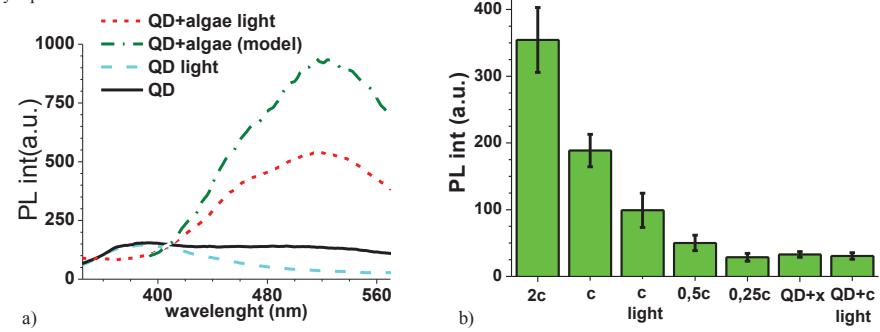
Light of a blue diode caused decrease of algae autofluorescence. Photobleaching of chlorophyll fluorescence was reversible. However, the blue light also caused irreversible negative effects on growth of microalgae population. The final algae concentration in samples with QDs was about 25% of the control after a month (Fig. 1b). The damaged cells were seen in the pictures of samples with CdSe QDs taken by means of fluorescence microscope, but not in the samples without QDs, implying that the fragmentation of QDs induced death of algae cells.