Chitosan is a deacytelated by-product of chitin, which is one of the most abounded polymeric material on the planet. It has good sorption ability in aqueous solution for heavy metals [1], though there are the limitations of chitosan application as sorbent in practise due to its lower sorption rate than other sorbents. One way of improving chitosan's sorption rate is by altering its physical properties. The nano sized chitosan granules increase the sorption dramatically due to a high surface area per unit mass and a porous structure [2].
Special case of liquid atomisation is electrospraying. This technique is used for generation of liquid droplet spray, strongly influenced by an electrical field. This process consists of liquid capillarity, a droplet breakdown in the electric field, a working mode of the spray selection and aerosol particle neutralisation in the chamber [3].
In order to determine aerosol particle formation, chitosan was diluted in the citric acid with palladium salt (Pd2Cl3.H2O) and ejected by an electrospray generator (EAG; TSI 3480). For generated chitosan particle evaluation data from a scanning electrical mobility particle sizer (SMPS; TSI 3936) was used to measure particle size distributions. SMPS was measuring particles in the range from 6 nm to 294 nm, each scan composed of an up-scan duration 120 s and a retrace - 15 s.
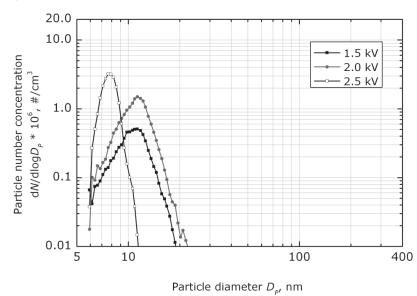
The most efficient way to generate aerosol nanoparticles is then the EAG is operating in the cone-jet mode. For chitosan aqueous solution the high voltage (HV) was varying in the range from 1.5 kV to 3.5 kV. In (Fig. 1) shows dependence of HV affects particle size distribution at fixed chitosan-palladium complex concentration of chitosan 1.5 g/L. The generated aerosol particles were observed in the nucleation mode cluster. Difference in particle distributions, can be explained by the operating modes of EAG, which are controlled based on HV and liquid property.