
One of the most rapidly growing branches of modern physics is ultrashort light pulse generation, amplification, control, detection and application. It granted possibilities for scientists to observe and control microscopic processes in nuclear, plasma, solid state electronics and high energy density physics. Experiments require high stability of the light beam, which is often interfered by vibrations, temperature, moving air, experimentator and etc.
Our scientific group is developing high energy ultrashort pulse generating laser system NAGLIS at VU Laser research center. In order to apply such system in strong electromagnetic field experiments, optical beam will be focused in area smaller than few tens of μm. Thus the accuracy of beam position must also be within this range – round ±(5-10) μm. For this reason, we are developing beam position tracking and correcting system.
System has few fundamental parts (Fig. 1): position sensitive device (PSD) generating currents (for x and y positions) proportional to intensivity of beam, analog signal to digital converter (ADC), microcontroller unit (MCU) controlling and gathering data from PSD and sending it to personal computer (PC). PC makes data available for experimentator, calculates amount, length and direction of steps which motors have to make and gives orders to driver controlling motors. There are four motors, one pair per mirror for x and y position control.
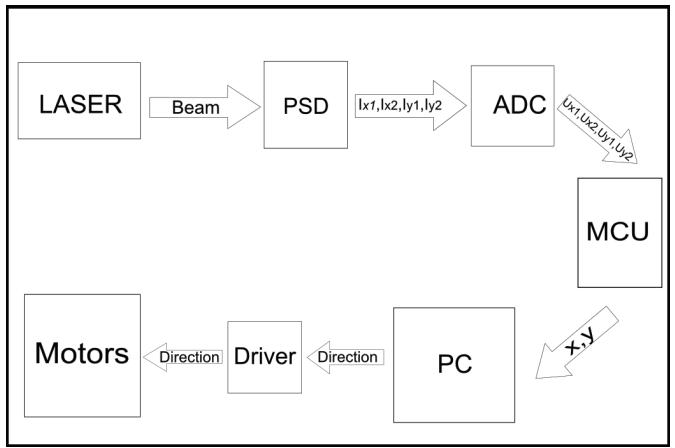
Similar stabilization system was presented in Japan in 2005. It was able to increase stability of beam focus from ~70μrad (without stabilization) to less than 10μrad (with active stabilization). Such results can only be achieved by high resolution mechanical devices, low noise and high speed electronic devices. Piesomotors that will be used in our system will have <30nm resolution.
The hardest part to implement is electronical (PSD-ADC in Fig. 1.) because of high precision, speed and size requirements. It is difficult to delay photocurrents in order to digitalize them with 16-18 bits resolution when working with ultrashort pulses. This system must also not influence other beam properties and it may be a problem because of high energy of the beam. Programming of MCU and PC software is also needed. We have developed program on MCU to read data from ADC and send it to PC. PC software is programmed with Labview (National Instruments) because of it's capability of working with different devices, in our case – MCU and piesomotors driver.