
OPCPA technology provides the means to get high pulse energies, high repetition rates and achieve 5-10fs pulse widths. One of the biggest challenges when producing an OPCPA system is to create a laser that would serve as its pump source as the output beam parameters of an OPCPA system depend very much on the output beam parameters of the pump source. It's very important that the pump source would have a homogenous spatial intensity distribution and high beam quality.
Our main goal was to create a laser amplifier system that would serve as a good pump source for an OPCPA system. We've managed to create a system that provides $\sim$80W average power at 1 kHz repetition rate with pulse widths of $\sim$50ps with intensity distribution resembling a hyper Gaussian distribution of 3rd order in the near field [1]. The measured M2 parameter of the output beam was $\sim$6 for both axes. This led us to an idea of conducting experiments on beam quality optimization. The results of our experiments using an adaptive optics to optimize beam quality are provided in this paper.
Deformable mirror was chosen as our adaptive optical element. It was a 37 channel micro machined membrane mirror with electrostatic actuators made by Flexible Optical B.V. The reflective area of it was circular with a 15mm diameter and the actual working area where the actuators are located was 12 mm in diameter. The reflective area is metallic with additional dielectric coating to provide best reflectance possible.
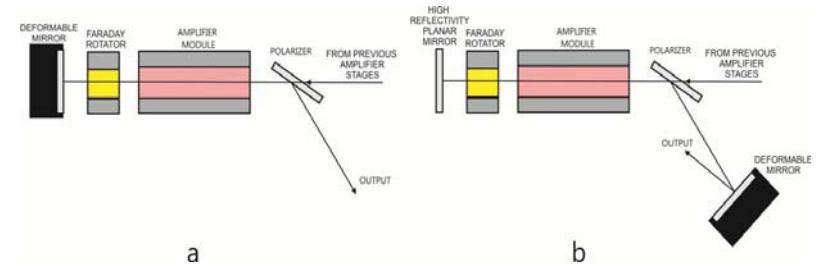
The mirror was used in 2 different configurations. In one the mirror was used as a replacement for an ordinary planar mirror with high reflectivity dielectric coating that is used as the returning mirror in the last (3rd) of the 2-pass amplification stages (Fig. 1a). But usage of this configuration resulted in damage to the active medium of the amplifier during the optimization process. So a layout where the mirror was placed at a small angle to the output beam was chosen for further experiments (Fig. 1b) The feedback for the deformable mirror was provided by reflecting a small fraction of the output beam using 2 wedge shaped glass plates and focusing it using a lens, then a camera (CMOS) is placed close to the beam waist. An algorithm was then run changing the voltages on the actuators and searching for ones that would provide the brightest image and one with smallest dimensions.
Using the aforementioned experimental layout the M2 parameter value of the output beam was reduced from $\sim$6 to $\sim$4 (All M2 parameter values were obtained using manual z-scan and software provided with the CCD camera). The difference between the intensity distributions at the beam waist was clearly seen using a CCD camera with an obvious change for the better for the optimized beam. Some considerations about use of deformable mirrors will be presented.