
Light emitting diodes (LEDs) are promising sources for all lighting applications. The spectrum of common white LEDs (wLEDs) consists of an intensive peak in a blue region and a broad band in the yellow region. However in 2001, a non-visual photoreceptor in human retina was proven to exist [1]. This receptor responds to blue light and is responsible for biological effects such as alertness, circadian rhythm, blood circulation, etc. While during the day time blue light improves biological performance, in the dark time it can disturb circadian rhythm [1]. For this reason it is important to optimize spectra of LEDs used for outside applications under mesopic contitions. Theoretical optimization of a lightsource for outdoor applications using mesopic photometry is described in ref [2].
In this work, the chromaticity coordinates of spectral power distributions (SPDs) of a blue 440 nm LED and various yellow (garnets, silicates) and orange (silicates, selenides, aluminates) phosphors were calculated. Obtained data was used to model LEDs with SPDs that match the blackbody radiation. The chromaticity coordinates of modeled LEDs are shown in Fig. 1.
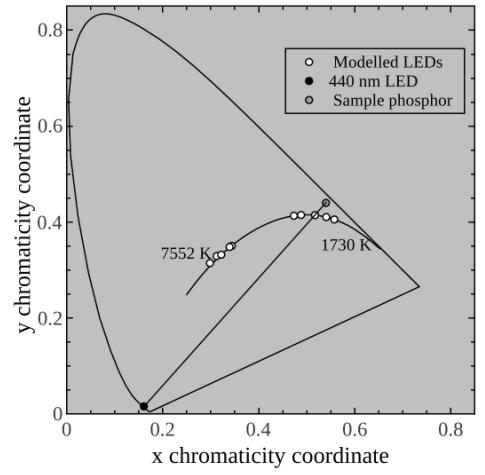
To characterize obtained SPDs, parameters like correlated color temperature (CCT), color rendition index (CRI), luminous efficacy of radiation (LER) and circadian action factor (CAF – the ratio of circadian efficacy of radiation and LER) were calculated.
| Phosphor | CCT, K | CAF, blm/W | LER lm/W | CRI | ||||
|---|---|---|---|---|---|---|---|---|
| (0.3 cd/m2) | (2 cd/m2) | (0.3 cd/m2) | (2 cd/m2) | Photopic | (0.3 cd/m2) | (2 cd/m2) | ||
| Garnet | 6513 | 0.636 | 0.716 | 385 | 342 | 63 | 85 | 73 |
| Orthosilicate | 2542 | 0.214 | 0.208 | 338 | 347 | 55 | 82 | 68 |
The results have shown that light sources, with smaller CCT values have lower values of CAF which means that they affect circadian rhythm less than the ones with high CCT. On the other hand, these kind of light sources tend to have lower values of CRI which makes lighting less pleasant for people. However, under mesopic conditions human ability to differ colors reduces thus the CRI value in this case a bit increases. The obtained results well agree with theoretical values.