
The influence of aerosols particles on health and climate are not yet completely examined. It is known that aerosols have significant influence on climate change. Some of them have ability to cool down the atmosphere, while others absorb sun radiation and increase temperature. Aerosols containing black carbon (BC) represents second category. BC is prevailing in every common background but higher concentrations can be observed in urban environment.
Continuous measurements of black carbon (BC) aerosols mass concentration were performed at a background site Preila from September to December, 2012 period. This was used to characterize BC temporal variation of mass concentration over the East Baltic region. An aethalometer was deployed at the site and provided real-time, continuous measurements of the BC mass concentrations. Measured light attenuation was converted to BC mass. The optical transmission of carbonaceous aerosol particles was measured sequentially at seven wavelengths $ \lambda $ (0.37, 0.45, 0.52, 0.59, 0.66, 0.88 and 0.95 μm). The BC mass concentration measured at the 0.88 μm wavelength is considered to represent BC in the atmosphere as at this wavelength.
It was obtained and compared concentrations of BC of different seasons. To obtain higher accuracy, this included corrections of concentration, attenuation and other optical properties. Also, the calculation of Ångström exponent was performed. This exponent is usually used to describe the dependency of the aerosol optical thickness, or aerosol extinction coefficient on wavelength. Ångström exponent enabled identification of BC source. This is the reason of it significant importance in optical methods.
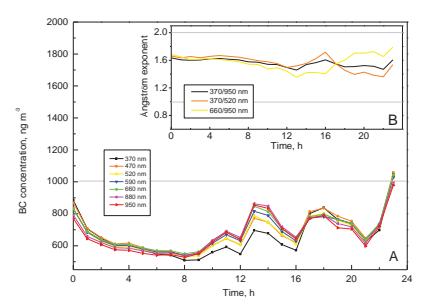
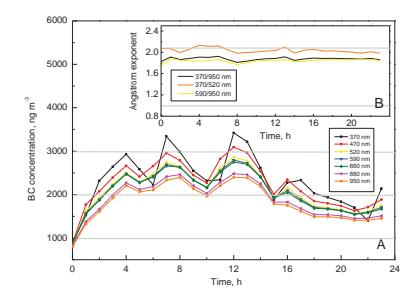
Analysis of the data revealed that during warm season concentrations and Ångström exponent values were low and varied in the range from 100 to 2000 ng m-3 of BC and exponent from 1.2 to 1.7 (fig. 1), while during cold season concentrations (from 1000 to 5000 ng m-3) and Ångström exponent values (from 1.6 to 2.1) were markedly higher (fig. 2). This difference in Ångström exponent indicates that aerosols from diesel fuel burning predominate in summer and biomass burning has higher influence during winter.