
Dwarf irregular galaxy Leo A is one of the most isolated galaxies in the Local Group. Lack of any neighbors means that this galaxy evolved naturally. Its metallicity is very low $Z = 0.0005$ [1], and ~80% of its baryonic mass still remains in the gas phase [2]. Study of this type objects can help us better understand processes and dynamics governing the evolution of galaxies. Previous studies of Leo A star formation history (SFH) covered large timescales [3, 4] and were unable to achieve high time resolution. In order to improve time resolution, SFH was derived only for the last 300 million years (Myr) using blue loop (BL) and main sequence (MS) stars.
Observation data from Subaru SuprimeCam (50% completeness limit $I \sim 24$ mag) and Hubble ACS (50% completeness limit $I \sim 28$ mag) and isochrones of $Z = 0.0004$ [5] were used. Salpeter IMF in the mass range from $0.5$ to $100$ M☉ was used for population modeling. Both the BL and MS methods complement each other. The MS method works well for youngest ages, however, for older ages (because of different age stellar population overlap in the color-magnitude diagram) it is difficult to apply it reliably. In Fig. 1 three MS older age data points are located much lower than those derived from BL stars, and were excluded from further analysis. The BL method on the other hand is not reliable at younger ages (< 50 Myr) because there are too few stars that could be used to compute the star formation rate (SFR).
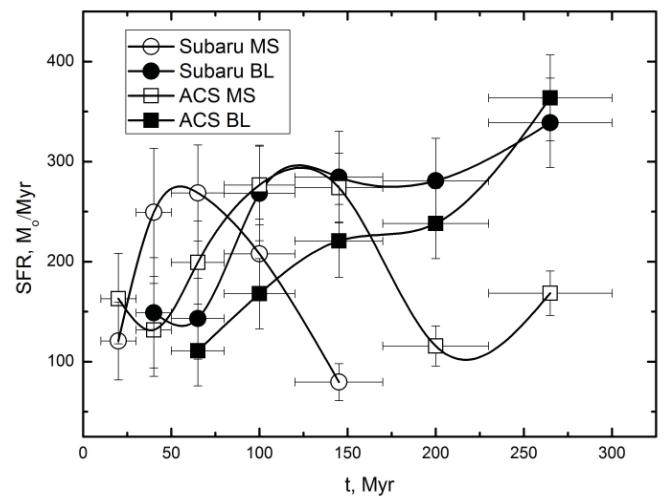
The results (Fig. 1) show that SFR in Leo A galaxy has steadily declined from ~350 M☉/Myr at the age of 300 Myr to ~150 M☉/Myr at 30 Myr. These results are in good agreement with previous determinations [3, 6].
The significantly different distribution of the MS stars (younger than 170 Myr) and the BL stars (younger than 300 Myr) in the galaxy was demonstrated. This discovery permits evaluation of the velocity of star forming regions in the Leo A galaxy.