Composite thin films consisting of the mixture of two materials have a wide range of applications [1-3]. The possibility to tailor the refractive index of materials is very attractive and has motivated the development of structures like gradient refractive index coatings. Mixture coatings present particular advantages, like reduced scattering losses, better mechanical properties [4] and higher resistance against radiation [5].
Nb2O5-SiO2 mixture coatings were deposited on fused silica by two different techniques: magnetron sputtering (MS) and electron beam ion assisted deposition (EB IAD) method. In basic magnetron sputtering process a target is bombarded by energetic ions generated in glow discharge plasma. The bombardment process causes the removal of target atoms, which then condense on a substrate as a thin film. Examples include hard, wear-resistant, low friction, well-adhered coatings. The particles evaporated by electron beam are less energetic than sputtered. To compensate the lack of particles energy additional ion assistance is used. It helps to achieve better optical, physical and mechanical thin film properties.
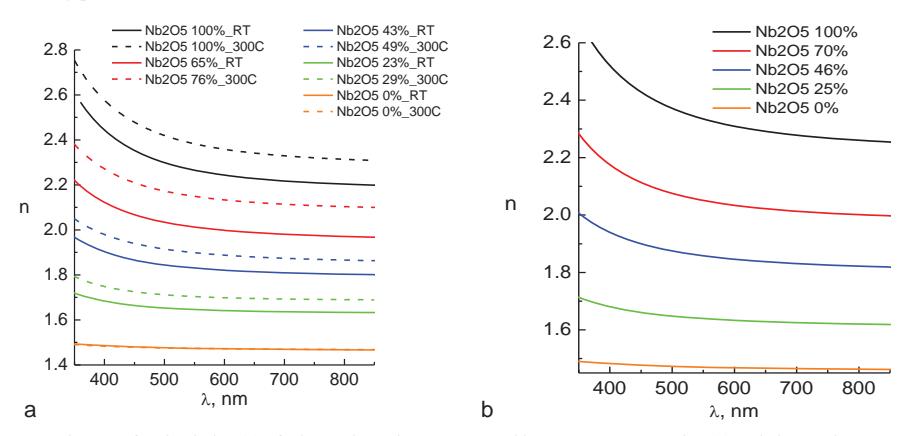
Single layers of pure materials and three mixtures were deposited. Transmittance measurements were performed in spectral range from 250 to 1300 nm. Refractive index and extinction coefficient were calculated using “OptiChar” from transmittance spectra. Fig. 1 shows determined refractive index of Nb2O5-SiO2 mixtures prepared by two different deposition techniques. Decreasing Nb2O5 fraction influences decrease of refractive index. Surface roughness of coated and bare substrates was measured by atomic force microscope (AFM). To characterize the structure and stoichiometry of layer X-ray diffraction (XRD) and X-ray photoelectron spectroscopy (XPS) measurements were done. To determine band gap of mixtures Tauc's model was used.