
Multidimensional potential surface determines the structure and spectral characteristics of molecular systems. In case of formation of a hydrogen bond the special interest represented the potential surfaces associated with the movement of the hydroxyl hydrogen atom of the donor molecule. Equilibrium position of the hydrogen atom in the hydrogen bridges are often very mobile and can be changed under the influence of the environment. In this study we investigated the effect of solvent on the spectroscopic and structural parametries of the pyridine n-oxide/trichloroacetic acid complex complex. For a free complex, as well as for the complex in chloroform, acetonitrile and water were calculated equilibrium geometrical parameters, and the characteristics of the IR spectra. According to the the calculations, surrounded by solvent molecules hydrogen bridge length in the complex decreases. Stretching vibration of the hydroxyl group exposed to significant red shift. A more detailed comparative analysis of changes in the shape of the potential surface was performed for free complex and the complex in acetonitrile. Fig. 1 shows the potential curves related to the stretching vibrations of OH groups in the free complex and Fig.2 - in the complex in acetonitrile.
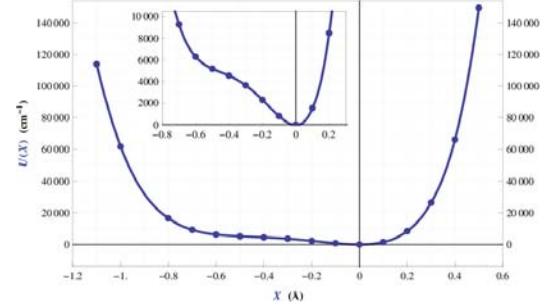
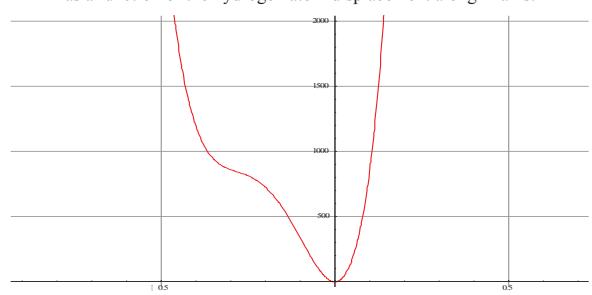
For the free complex the depth of the potential well for the free complex is about $4000 \text{ cm}^{-1}$. In the complex, dissolved in acetonitrile, the well depth is reduced to $800 \text{ cm}^{-1}$ (Fig. 2). There is in addition the shift of the global minimum to the center of the hydrogen bridge. As can be seen from Fig. 1, on the right of the minimum the slope of the potential curve is comparable to the usual covalent chemical bonds. However, on the left, down to the displacement of the order of 0.6 Å, the slope of the potential curve is much smaller than in the case of ordinary chemical bonds. Here the attraction of the oxygen donor offset the attraction of the acceptor oxygen. Only since the deviation of 0.8 Å the potential energy begins to increase sharply as the attraction of the acceptor oxygen is replaced by repulsion.