
Even though NMR spectrometry techniques reached a considerably high level upon its origins, its application was limited to research of liquid sate materials for a long period of time. In solid state materials we get a wide structureless NMR band. This is due to more complex inner interactions. The main reason for this broadening of the signal is the reciprocity of spins as magnetic dipoles, which hide other spectral structures of weaker interactions, thus making them uninformative.
The local magnetic field, caused by the i nucleus at the location of the j nucleus:
$$B_i = \mu r_{ij}^{-3} (3\cos^2\theta_{ij} - 1);\tag{1}$$If the angle in the spin pair is
$$\theta_{ij} = \cos^{-1}\frac{1}{\sqrt{3}} = 54^{\circ}44';\tag{2}$$then the reciprocity disappears. But only a small portion of the nuclei meets this criterion.
In liquids, where the molecular movement shifts the positions and orientations of the molecules at a high rate, the local fields average value becomes equal to zero. However, in solid state materials this field will have different values in different locations of the body. If we were to rotate the spin pair ij around any axis, then the components of the vector rij, which are perpendicular to the axis of rotation averages themselves and becomes equal to zero. The effect value of the rij vector becomes equal to its projection rotation axis. Thus, if we were to turn the whole spin ensemble at an angle of 54°44′ compared to the external polarizing field B0, the broadening of the resonance band due to the the dipole interactions is negated.
Magic Angle Spinning (MAS) is used routinely in the most of solid state NMR experiments, where its primary task is to remove the effects of chemical shift anisotropy and to assist in the remove of heteronuclear dipolar-coupling effects. It also used to narrow lines from quadrupolar nuclei and it is increasingly the method of choice for removing the effects of homonuclear dipolar coupling. It requires very high spin rate.
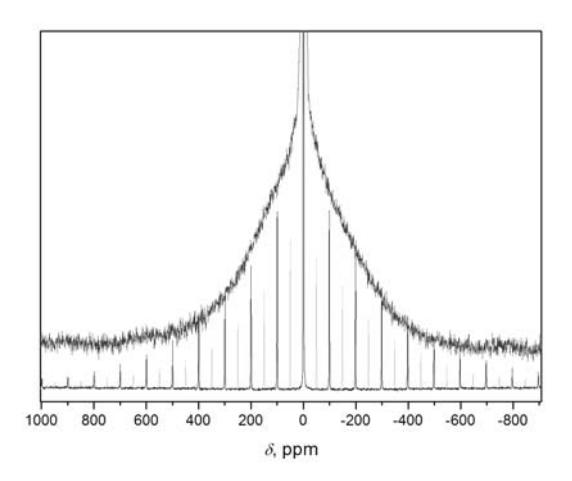
The aim of the report is to review MAS method in NMR spectrometry and present its possible applications in scientific research.